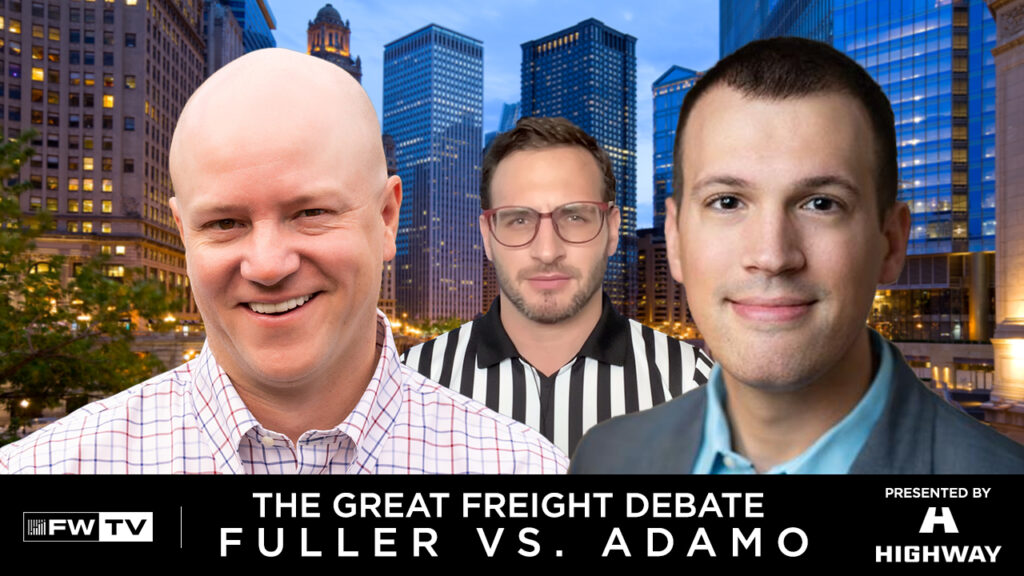
A recent debate between SONAR’s Craig Fuller and DAT’s Ken Adamo, moderated by Matt Leffler, explored the deep-seated challenges facing the freight industry, from market dynamics to regulatory failures and the rise of automation.
A Challenging Market
The discussion began by addressing the current “freight recession,” one of the worst in generations. The market is defined by an oversupply of capacity and anemic demand, with truckload volumes down double-digits year-over-year. Ken Adamo noted, “I do think that volume is tough because the economy stinks. The economy stinks, especially the consumer economy.” While spot rates are “slowly melting up,” the lack of volume creates a difficult environment, especially for freight brokers.
Enforcement, Immigration, and Driver Qualifications
A significant portion of the debate focused on driver qualifications and increased regulatory enforcement. Craig Fuller argued that policies allowing non-domiciled CDLs and lax oversight of driver training schools have created an “endless supply of labor,” with a large number of drivers who may not meet federal requirements, including English Language Proficiency (ELP). He cited insurance industry estimates that as many as 10% to 40% of drivers do not speak English. Fuller believes enforcement will intensify, stating, “it’s a very safe place for the administration to be able to attack the immigration issue.”
Ken Adamo countered that the number of non-compliant drivers is much lower, around 1.5%, and that equipment maintenance issues are a more pervasive problem. The debate highlighted a potential shift in the market, where shippers concerned about liability may favor larger, asset-based carriers who can certify their drivers’ compliance.
The Driver Shortage and Safety Failures
The perennial topic of a “truck driver shortage” was also contested. Adamo put forward his “burger kiosk fallacy,” arguing a shortage does exist but has been masked by accepting the “externality of unsafe roads, unsafe equipment, and untrained or undertrained drivers.”
Fuller disagreed, stating there is no long-term shortage. He argued that the market naturally corrects for temporary capacity crunches with higher wages and incentives. The real issue, according to Fuller, is the failure of the Federal Motor Carrier Safety Administration (FMCSA) to enforce its own rules. Both speakers agreed that the agency’s lack of enforcement has created an environment where compliant carriers struggle to compete. As moderator Matt Leffler put it, “If you did everything right as a motor carrier in The United States, you would go out of business.” This issue is underscored by the fact that approximately 93% of motor carriers have no official safety rating from the FMCSA.
The Inevitable Rise of AI
Looking ahead, the conversation shifted to automation, which was framed as the third major revolution in freight after containerization and deregulation. “The fact of the matter is the technology is already so good,” Adamo said. “A lot of folks don’t even realize they’re talking to an AI.” Both speakers see the adoption of AI and eventually autonomous trucks as a matter of “when,” not “if.” Fuller suggested that rising driver wages, spurred by increased enforcement, will accelerate investment in autonomous technology, with driverless trucks potentially becoming socially and legally acceptable for point-to-point transport by 2035 or 2040.
Outlook
The debate concluded with a sober near-term forecast. The upcoming winter is expected to be difficult, with a significant “capacity washout” and potential bankruptcies of large carriers and brokers possible by next spring. The consensus was that meaningful change requires advocacy, as policymakers remain largely unaware of the industry’s complex challenges.
Watch the recording of the full debate here.