Freight doesn’t all pay the same, and the gap between the cheapest and most expensive freight on the road shows up on a carrier’s income statement long before it shows up on a police report — or a nine-figure jury verdict.
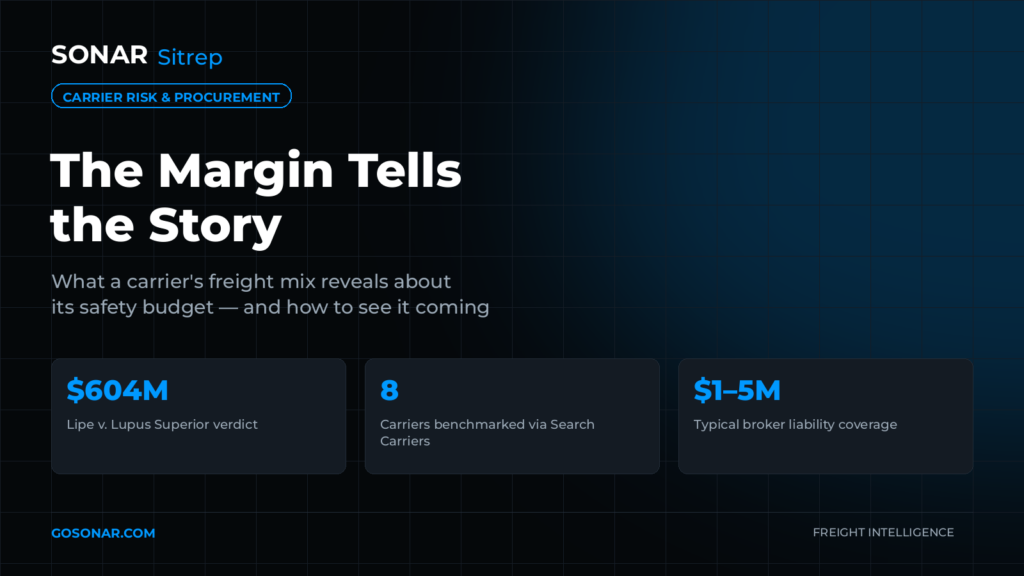
That’s the starting point of SONAR’s newest SitRep, The Margin Tells the Story, which uses SONAR’s Search Carriers tool to pull back the curtain on eight real carriers — what they’re actually hauling, what their safety data says, and what that combination implies about how much room they have to reinvest in maintenance, driver retention, and adequate insurance.
Key Takeaways
- Commoditized freight compresses margin, and margin funds safety. Beverages, cans, and general retail dry van freight are among the most heavily bid-down categories in the market. Thin margin limits what a carrier can reinvest — and that shows up in out-of-service rates and BASIC percentiles.
- A “Satisfactory” FMCSA rating can lag years behind a carrier’s current risk. The SitRep uses Search Carriers data to show why the rating cited in Lipe v. Lupus Superior — the case behind a $604 million verdict against C.H. Robinson — didn’t reflect the carrier’s real-time BASIC scores.
- Most small carriers don’t even have a rating to lag. More than 90% of authorized motor carriers operate with no FMCSA safety rating at all, so the SitRep shows what’s still visible in Search Carriers when there’s no rating to check.
- Broker insurance capacity is wildly uneven. Most brokerages carry $1–5 million in their own liability layer. Only a couple of the largest brokers in the industry — C.H. Robinson and RXO among them — carry $100 million or more, and even that wasn’t enough to cover the Lipe verdict.
- The pattern doesn’t always hold — and that’s the point. One carrier in the SitRep hauls a freight mix that’s nearly two-thirds paper and tissue products, a textbook commoditized category, and still posts the cleanest safety profile of any carrier reviewed. Freight mix is a signal worth checking, not a verdict to assume.
Why This SitRep Exists
Most carrier vetting stops at a certificate of insurance and an FMCSA safety rating. Neither one tells a shipper or broker what a carrier has actually been hauling — or whether that freight has paid well enough to fund the maintenance program, the driver retention, and the insurance tower behind the DOT number.
SONAR’s Search Carriers tool puts a carrier’s Recent Shippers panel next to its BASIC percentiles, out-of-service rates, and Estimated ISS Score — in one view. This SitRep walks through what that combination looks like across eight carriers with very different freight profiles, from a 23-truck Texas carrier hauling beverage cans to a 44,000-unit multimodal giant hauling everything from Amazon to automotive parts.
It also breaks down a piece of the insurance market most shippers never see: what a typical freight brokerage actually carries in liability coverage, how that compares to what C.H. Robinson and RXO disclose, and why even a $155 million tower wasn’t enough in Lipe v. Lupus Superior.
Read the Full SitRep
The complete report — full carrier-by-carrier breakdown, Search Carriers screenshots, the broker insurance comparison table, and the shipper vetting playbook — is available now:
- SONAR Platform subscribers: Find it under Research in the SONAR Platform. Included for all enterprise subscribers.
- Self-serve access: FreightWaves Market Monitor also carries SONAR SitReps as individual research unlocks, with self-serve subscription plans starting at $199/month at getfreightdata.com.
Frequently Asked Questions
What is a SONAR SitRep? A SONAR SitRep is a freight market intelligence report that combines SONAR’s proprietary index data, FMCSA safety data, and public financial filings into a single research brief on a specific market dynamic. SitReps are published regularly and cover topics ranging from carrier safety and broker liability to freight demand and rate forecasting.
What is SONAR Search Carriers? Search Carriers is a risk-management application inside the SONAR Platform that lets users look up any FMCSA-registered motor carrier and see its safety ratings, BASIC percentiles, out-of-service rates, Estimated ISS Score, equipment and fleet details, and — through the Recent Shippers panel — which companies it has recently hauled freight for.
How can shippers use freight mix to vet a carrier? A carrier’s Recent Shippers panel shows what kind of freight it typically hauls. Shippers can use this to find carriers with proven experience in their specific commodity type, and to flag when a carrier’s freight mix is concentrated in low-margin, highly commoditized categories that may limit its ability to invest in safety and insurance. It’s one signal among several, not a standalone verdict.
Why does broker liability insurance matter after the Montgomery ruling? The Supreme Court’s May 2026 ruling in Montgomery v. Caribe Transport II cleared the way for state-law negligent-hiring claims against freight brokers. Since then, broker liability coverage has become a bigger differentiator: most brokerages carry $1–5 million in coverage, while only a handful of the largest brokers carry $100 million or more — and even that wasn’t enough to cover the $604 million verdict in Lipe v. Lupus Superior.
Where can I access this SitRep and others like it? Enterprise subscribers can find all SONAR SitReps under the Research section of the SONAR Platform. Individual SitReps are also available as self-serve research unlocks through FreightWaves Market Monitor at getfreightdata.com, with subscription plans starting at $199/month.
SONAR is the leading real-time freight market intelligence platform, tracking 500+ proprietary indices across truckload, LTL, intermodal, rail, air, and ocean freight. Learn more at gosonar.com.
For more info like this, check out https://gosonar.com/freight-market-blog/capacity-under-pressure