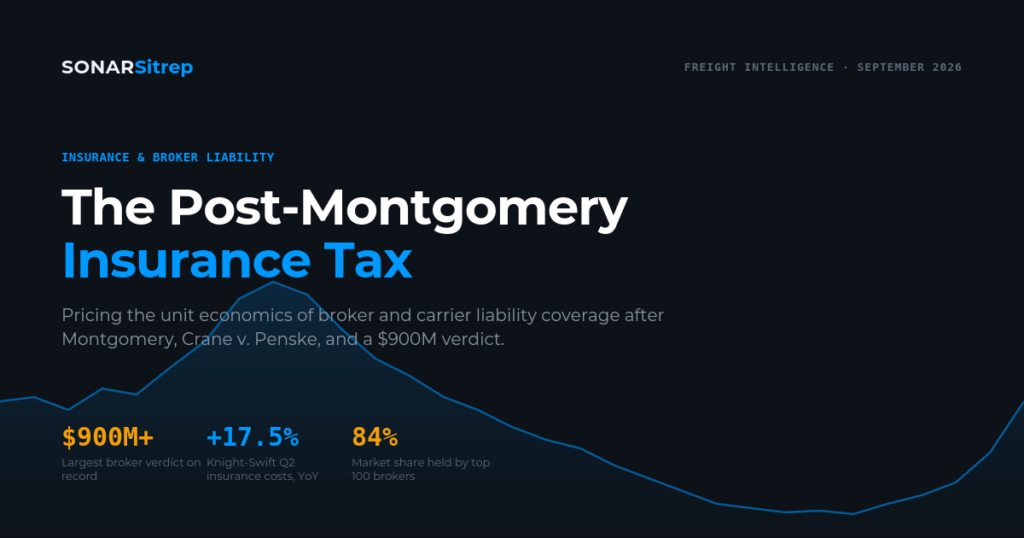
Quick answer: Freight broker liability insurance costs are rising sharply in 2026 after the Supreme Court’s May ruling in Montgomery v. Caribe Transport II, which removed brokers’ main legal shield against negligent-hiring lawsuits. Primary coverage is up roughly 40–60% on renewal. Excess and surplus layers — the coverage that protects against nine-figure verdicts — are up 50% to over 300% in documented cases. Small brokers are seeing the steepest relative jump, with some renewals moving from $10,000/year to $30,000–$40,000/year.
Key takeaways
- The May 14, 2026 Montgomery v. Caribe Transport II Supreme Court ruling removed the FAAAA safety-exception defense that had shielded brokers from state negligent-hiring lawsuits for roughly two decades.
- A July 23, 2026 verdict in Lipe v. Lupus Superior — over $900 million, with C.H. Robinson facing $600M+ as broker of record — is the case insurers are now pricing against.
- Primary broker liability coverage is up ~40–60%; excess/surplus layers are up 50% to over 300%, including a documented case of one broker’s excess premium moving from $3M to $10M.
- Only two brokers, RXO and C.H. Robinson, are known to carry more than $100M in excess liability coverage.
- SONAR’s own capacity data confirms tightening in Illinois but not in California, despite both being named by insurers as pullout states.
What was the Montgomery v. Caribe Transport II ruling?
Montgomery v. Caribe Transport II is a May 14, 2026 Supreme Court decision holding that federal law does not shield freight brokers from state negligent-hiring lawsuits. It eliminated the FAAAA safety-exception defense that brokers had relied on for roughly two decades. Justice Kavanaugh’s concurrence noted that liability isn’t automatic under the ruling — but insurers have treated the risk as real, and pricing has moved accordingly.
Three months later, Crane v. Penske Transportation Management (5th Cir., Aug. 4, 2026) extended liability further up the chain, holding that a carrier can be a driver’s “statutory employer” even when several outsourcing steps removed from the driver’s actual operation. Trade groups have asked for a full appellate rehearing; a ruling is still pending.
The $900 million verdict insurers are underwriting against
On July 23, 2026, a Dallas County jury returned a verdict exceeding $900 million in Lipe v. Lupus Superior, with C.H. Robinson — as broker of record — facing more than $600 million of that exposure. Part of the jury’s reasoning: the driver’s use of C.H. Robinson’s own tracking app allegedly made him a “borrowed employee” at the moment of the crash. Brokers are reportedly reassessing how much carrier-tracking technology they use as a result.
Two underwriters have already exited the broker auto liability market entirely since May 2026. TD Cowen puts the remaining underwriter pool at around 10, trending toward 8.
How much are freight broker insurance costs actually increasing?
The increases are layered, not flat, and scale with the size of the coverage rather than the size of the broker:
- Primary coverage (first $5M): roughly 40–60% increase on renewal
- Excess/surplus coverage (above $5M): 50% up to triple-digit percentage increases — one documented case moved from $3M to $10M in premium (a 233% increase)
- Small brokers ($30–40M in revenue): renewals moving from roughly $10,000/year to $30,000–$40,000/year, a 3–4x increase
- Top-10 brokers: premiums have tripled on renewal, per TD Cowen’s August 2026 research
- Broad estimate for large brokers: mid-teens to mid-20s percent increases
Are all freight brokers affected equally?
No. The increases fall hardest on two groups: small brokers who can’t absorb a 3–4x cost jump, and any broker trying to carry adequate excess coverage. Only two brokers — RXO and C.H. Robinson — are known to carry more than $100 million in excess liability coverage, and Robinson’s tower just absorbed the largest broker verdict on record. With roughly 22,000 freight brokers in the U.S. and the top 100 already controlling 84% of the market, rising insurance costs alone may accelerate consolidation that was already underway.
Trailer pools are an emerging blind spot: standard commercial auto policies frequently exclude trailers “over the road” — exactly where most claims happen — and plaintiff attorneys are now bypassing small carriers to go straight after brokers and trailer-leasing companies instead.
Does the capacity data actually back this up?
We checked SONAR’s own tender rejection index (STRI) against the specific states insurers have named as pullback geographies. Illinois genuinely shows the tightest trucking capacity in the country right now — Quincy, IL ranks #1 of 135 tracked markets. Ohio is a wash, roughly at the national average. California, also named as a pullout state, is actually looser than the national average across every market SONAR tracks — a real caveat worth watching next quarter, not a clean confirmation.
For the full breakdown of freight market conditions and rate indices referenced here, see SONAR’s freight market intelligence hub.
Frequently asked questions
What is the Montgomery v. Caribe Transport II ruling? It’s a May 14, 2026 Supreme Court decision holding that federal law does not shield freight brokers from state negligent-hiring lawsuits, removing a legal defense brokers had relied on for roughly two decades.
Why did C.H. Robinson’s insurance costs increase? C.H. Robinson faces more than $600 million in exposure from the July 2026 Lipe v. Lupus Superior verdict, the largest verdict against a broker on record. Its CFO has said insurance costs are expected to keep inflating year-over-year.
How much have freight broker insurance premiums gone up in 2026? Primary broker liability coverage is up roughly 40–60% on renewal. Excess and surplus coverage above $5 million is up 50% to over 300% in documented cases.
Which freight brokers carry the most excess liability coverage? Only RXO and C.H. Robinson are known to carry more than $100 million in excess liability coverage, according to TD Cowen research and company filings.
Is trailer insurance affected by the Montgomery ruling? Yes. Standard commercial auto liability policies often exclude trailers “over the road,” and plaintiff attorneys are increasingly targeting brokers and trailer-leasing companies directly rather than small carriers.
Is the insurance capacity pullback happening everywhere? Not evenly. SONAR’s data shows Illinois genuinely tightening, consistent with insurer pullback, while California — despite being named as a pullout state — is actually looser than the national average.
Get the full report
The full SONAR sitrep breaks down the legal timeline, Q2 2026 earnings data from Knight-Swift, C.H. Robinson, and Werner, TD Cowen’s complete analyst math, first-person interviews with insurers and underwriters, and an interactive calculator to estimate your own renewal exposure by broker size and coverage layer.
To access this sitrep and the rest of SONAR’s sitrep library, request a demo for a SONAR license or subscribe to FreightWaves Market Monitor at getfreightdata.com. Current SONAR enterprise subscribers already have full access to sitreps within the platform.