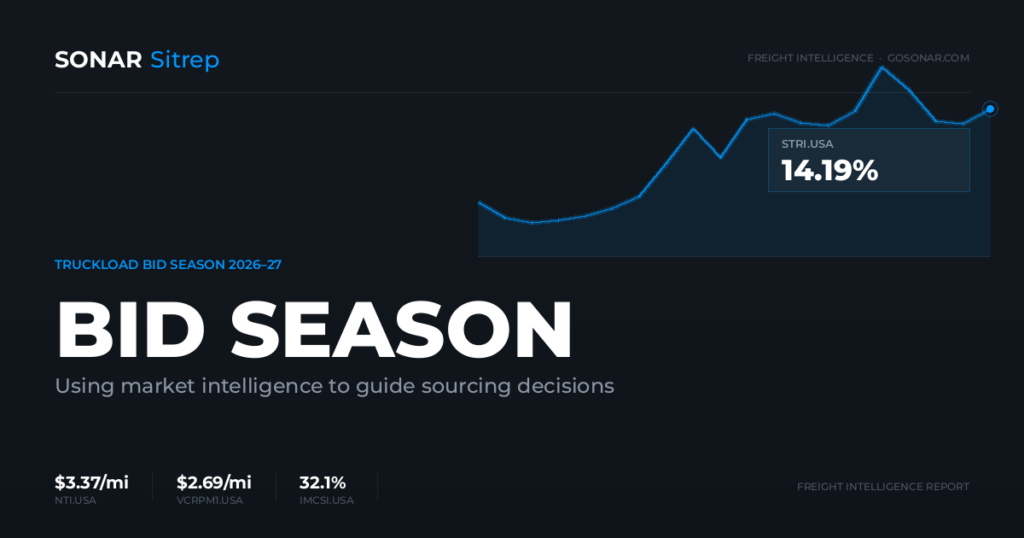
Truckload bid season is opening into one of the most volatile freight markets in years. SONAR’s Truckload Rejection Index (STRI.USA) sits at 14.19% as of September 1, 2026 — more than double its 2025 full-year average of 6.05%. Spot rates (NTI.USA) are up to $3.37/mile, contract rates (VCRPM1.USA) have climbed roughly 18% year-over-year to $2.69/mile, and the spot-to-contract spread has round-tripped from negative to +$0.55/mile and back to flat in just fourteen weeks.
If your bid strategy is built on a single point-in-time read of this market, it inherits all of that movement — whether you intend it to or not.
The Problem With a Network-Wide Bid
Most shippers still run bid season as one network-wide pricing exercise. But a single national STRI reading of 14.19% is hiding a lane-by-lane spread that ranges from under 3% to nearly 45% — an eighteen-fold difference sitting underneath one headline number. Treating every lane the same way leaves value on the table in some markets and risk on the table in others.
SONAR’s new Sitrep, Bid Season: Using Market Intelligence to Guide Sourcing Decisions, breaks the market down to the lane level and gives transportation teams a repeatable framework for deciding where to compete, where to protect, and where to watch.
What’s Inside the Report
- A market overview of the conditions shippers are bidding into, including the STRI, NTI, VCRPM1, and spot-to-contract spread trends behind this year’s volatility
- A four-question framework — cost position, lane market conditions, incumbent value, and credible alternatives — for deciding how any lane should be sourced
- A modal flexibility analysis, including a real lane-level truckload-vs-intermodal comparison using SONAR Intermodal Dashboard data
- Carrier relationship principles for keeping bids resilient when capacity is tightening
- A worked example combining shipper cost data with SONAR market signals across roughly 900 illustrative lanes, showing how a network sorts into protect, compete, and monitor categories
- A post-award monitoring framework for keeping a bid connected to the market after it’s signed
Why It Matters Now
Bid season isn’t a single event — it’s a portfolio decision made under conditions that can shift meaningfully within the length of one bid cycle. The shippers who get the most value from market intelligence treat it as a year-round discipline, not a once-a-year exercise bounded by the RFP calendar.
[Read the full Bid Season Sitrep at GoSONAR.com →]
Sitreps are available in the SONAR platform for current Enterprise subscribers. To access the full Bid Season Sitrep and the rest of the SONAR Sitrep library, request a demo for a SONAR license or subscribe to FreightWaves Market Monitor at getfreightdata.com.
Frequently Asked Questions
What is the SONAR Truckload Rejection Index (STRI.USA) right now? As of September 1, 2026, STRI.USA stands at 14.19%, more than double its 2025 full-year average of 6.05%, reflecting a significant tightening in carrier capacity heading into bid season.
How much have contract rates increased heading into the 2026–2027 bid cycle? SONAR’s contract rate index (VCRPM1.USA) has climbed to $2.69/mile, roughly 18% above year-ago levels, with the increase already showing up in newly reported awards.
What is the spot-to-contract rate spread and why does it matter for bid season? The spot-to-contract spread (RATES12.USA) compares spot linehaul pricing against contract base rates. A positive spread means spot is paying more than contract, making capacity harder to hold at a fixed rate. SONAR’s spread turned positive in May 2026, peaked near +$0.55/mile in early July, and has since eased back to roughly flat — a full round trip in about fourteen weeks.
Should shippers bid every lane in their network the same way? No. National indices describe the environment a bid is entering, not the rate any individual lane will produce. SONAR’s Sitrep recommends evaluating each lane individually against four questions: current cost position, lane-level market conditions, the value of the incumbent carrier relationship, and the depth of credible alternatives.
Is intermodal conversion worth revisiting this bid season? SONAR’s Intermodal Contract Savings Index (IMCSI.USA) has roughly doubled year-over-year to 32.1%, making the national environment more favorable for truckload-to-intermodal conversion. The report cautions that this is a starting point for a lane-level, cross-functional evaluation, not a lane-specific savings guarantee.
Data source: FreightWaves SONAR, as of September 1, 2026. Full methodology and lane-level detail available in the complete Sitrep — available in the SONAR platform for current Enterprise subscribers. Request a demo or subscribe via getfreightdata.com to access the full Sitrep library.