A complete timeline of US Trade Policy and what it means for freight.
U.S. Tariff War Timeline (2018–2026): Every Legal Authority, Rate Change, and What It Means for Freight
Published: September 2026 | SONAR Sitrep
TL;DR
- The legal basis for U.S. tariffs has changed four times since February 2025: IEEPA → Section 122 → Section 301/232/338.
- The Supreme Court struck down the IEEPA tariffs on Feb. 20, 2026, triggering an estimated $86.3 billion in CBP duty refunds.
- Canada and the U.S. are in their most adversarial trade posture in modern history — $20 billion-plus in goods now tariffed on each side, with no bilateral talks scheduled.
- SONAR’s own ocean data shows Southeast Asia transshipment volumes still climbing 31.7%–49.2% year-over-year, despite new enforcement mechanisms.
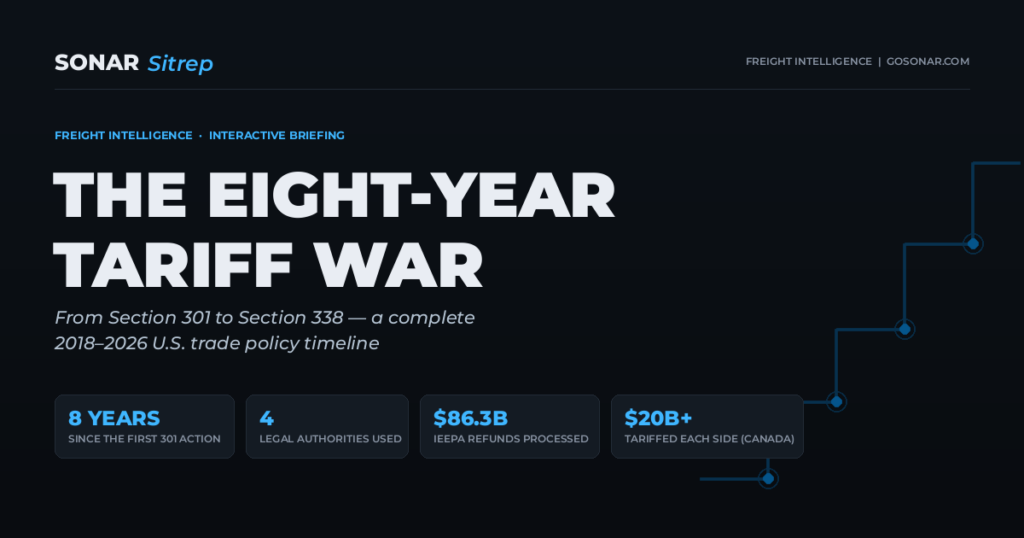
Eight years ago this spring, USTR published a Section 301 investigative report accusing China of forced technology transfer — the opening move in a trade dispute that’s still reshaping freight flows today. Since then, the legal machinery behind U.S. tariff policy has gone through more changes in the last eighteen months than in the previous six years combined. SONAR’s new Sitrep, The Eight-Year Tariff War, tracks the whole arc — from the original 2018 China tariffs through this week’s U.S.–Canada standoff — and pairs it with SONAR’s own freight and ocean-volume data to show what’s actually moving, not just what’s being announced.
When did the U.S. tariff war actually start?
March 2018, with a USTR Section 301 report on China’s trade practices. What followed was four escalating tariff “lists” through 2018–2019, eventually covering more than $360 billion in Chinese imports, with Chinese retaliation reaching roughly $110 billion of U.S. exports. The Phase One trade deal in January 2020 cooled things temporarily — and USMCA replaced NAFTA that July, with a built-in six-year review clause set for 2026. That review clause is exactly what reopened the current Canada and Mexico disputes.
Why has the legal basis for tariffs changed four times since 2025?
Because each time one legal authority hit a wall, the administration reached for a different one:
- Section 232 (reinstated Feb. 2025, steel/aluminum to 25%, doubled to 50% that June)
- IEEPA (Feb. 2025 fentanyl tariffs on Canada/Mexico/China, then the April “Liberation Day” reciprocal tariffs)
- Section 122 (invoked Feb. 20, 2026, the same day the Supreme Court struck down IEEPA — a 10% global tariff capped at 150 days)
- Section 301/232/338 (July–August 2026, after Section 122 hit its statutory expiration)
That last shift is the one worth understanding on its own: Section 338 of the Tariff Act of 1930 — a provision permitting duties up to 50% on countries found to discriminate against U.S. commerce — had never been used this way by any president until the administration invoked it against Canada on July 20, 2026.
What happened when the Supreme Court struck down the IEEPA tariffs?
On Feb. 20, 2026, the Court ruled 6-3 in the consolidated cases Learning Resources, Inc. v. Trump and Trump v. V.O.S. Selections, Inc. that the International Emergency Economic Powers Act doesn’t authorize the president to impose tariffs at all. The ruling invalidated both the April 2025 “Liberation Day” reciprocal tariffs and the fentanyl-related tariffs on China, Mexico, and Canada. CBP halted duty collection within days and began processing refunds — an estimated $86.3 billion repaid so far. The White House pivoted to Section 122 within hours of the ruling.
Is the transshipment problem actually getting better?
Based on SONAR’s own ocean data: no — if anything, it’s intensifying on the upstream leg. China’s shipments into Vietnam, Malaysia, Cambodia, and Indonesia are running 31.7% to 49.2% above baseline year-over-year, even as China’s own direct-to-U.S. ocean volume grew a comparatively modest 3.6%. That gap between goods arriving at the transshipment hubs and goods actually leaving for the U.S. has widened since the White House’s original August 2026 enforcement report — a signature more consistent with a growing processing backlog than a cooling trend.
How bad is the U.S.–Canada trade relationship right now?
Bad, and not obviously improving. Talks collapsed Aug. 21, 2026; Section 338 tariffs took effect the next day at 50% on roughly $20 billion of Canadian goods. Canada’s retaliation — covering nearly 700 U.S. product lines at rates up to 50% — took effect Sept. 8. Prime Minister Mark Carney’s response: “You’re at war when you get attacked. We got attacked.” No further bilateral talks are scheduled. Mexico, by contrast, has avoided retaliation entirely and its cross-border rail container volume is actually up 11.3% year-over-year — a real divergence in how the two USMCA partners are handling the same review-clause dispute.
What does this mean for shippers?
The full Sitrep breaks down six concrete impacts — including why landed-cost volatility is now a planning input rather than a risk to hedge away, and why sourcing shifted to Southeast Asia to dodge China tariffs is now a compliance risk rather than a savings play. It also covers what showed up in Q2 2026 earnings: retailers like Target and Walmart booked one-time IEEPA refund windfalls, while truck OEMs like Daimler and Volvo are still absorbing real tariff-driven margin pressure with no equivalent relief.
Frequently Asked Questions
What is Section 338, and why is it significant? Section 338 of the Tariff Act of 1930 lets the president impose duties up to 50% on countries found to discriminate against U.S. commerce. It had never been used this way until July 20, 2026, when the administration invoked it against Canada over auto-content rules, alcohol restrictions, and dairy quotas — leading to 50% tariffs on roughly $20 billion of Canadian goods effective Aug. 22, 2026.
Why did the Supreme Court strike down the IEEPA tariffs? On Feb. 20, 2026, the Supreme Court ruled 6-3 in Learning Resources, Inc. v. Trump and Trump v. V.O.S. Selections, Inc. that IEEPA does not authorize the president to impose tariffs, applying the major questions doctrine. The ruling struck down both the April 2025 “Liberation Day” reciprocal tariffs and the fentanyl-related tariffs on China, Mexico, and Canada, triggering an estimated $86.3 billion in CBP duty refunds.
Is the de minimis exemption really gone for good? Duty-free treatment under the $800 de minimis exemption has been suspended for every country of origin since Aug. 29, 2025 (China and Hong Kong lost it first, on May 2, 2025). The suspension survived the IEEPA ruling by riding on the Section 122 proclamation, and CBP made it indefinite through formal rulemaking in June 2026. Congress has separately voted to repeal the exemption permanently, effective July 1, 2027.
Is the “Great Transshipment Scam” pattern still happening? Yes — based on SONAR’s own ocean data, it has intensified. China’s shipments into Vietnam, Malaysia, Cambodia, and Indonesia are running 31.7% to 49.2% above baseline year-over-year, even as enforcement scrutiny increases. The gap between goods arriving at these hubs and goods leaving for the U.S. has widened since the original August 2026 report.
How exposed is Mexico compared to Canada? Differently. Mexico has avoided Canada-style retaliation and its rail container import volume is actually up 11.3% year-over-year, but its preferential USMCA access is tied to ongoing review talks deadlocked over a proposed 50% U.S.-content rule for vehicles. Canada, by contrast, is already under active 50% Section 338 tariffs with no bilateral talks scheduled.
Access the full Sitrep
The complete Eight-Year Tariff War Sitrep — full timeline tables, the transshipment lane-by-lane data, the Canada/Mexico/EU/China country tracker, and the Q2 2026 earnings breakdown — is available now:
- Current Enterprise SONAR subscribers: available in-platform today.
- Not yet a subscriber? Request a demo.
- FreightWaves Market Monitor subscribers: access via getfreightdata.com.
Data source: SONAR Global Trade Command Center, USTR, White House proclamations, CBP guidance, and Congressional Research Service, as of September 2026. Full methodology and lane-level detail available in the complete Sitrep at GoSONAR.com.