Comparing intermodal data to truckload fills in the blanks
All modes in one place
The new Intermodal Dashboard makes SONAR easier to use. The idea is simple: users select from a list of dense intermodal lanes and, with one click, all relevant volume and rate data for both intermodal and truckload are presented and charted. From there, many observations and inferences can be made about the competitive dynamics across modes. Here are three lanes as examples:
LA-to-Chicago – Truckload is of little threat to intermodal
That is the densest intermodal lane, and SONAR data suggests the value proposition in that lane remains very strong. The intermodal contract rate of $1.39/mile is well below the truckload contract and spot rates of $2.16/mile and $1.99/mile, respectively (all rates include fuel). The fuel-inclusive spread has widened in the past few months (currently 35%) as truckload rates have trended upward.

(SONAR: Intermodal Dashboard)
Aside from rates, intermodal service levels are critical. Obtaining true intermodal service data, such as transit time variance from service plans, is difficult. But volume data provides insight into service. Intermodal volume is not just a function of demand, but also of whether shippers are finding value in service.

Year-over-year changes in loaded domestic containerized intermodal volume outbound from Los Angeles (white) and long-haul truckload tenders (>800 miles) outbound from Los Angeles. (Chart: SONAR)
Long-haul (>800 miles) truckload tender volume (an indicator of truckload demand for lengths of haul that may compete with intermodal) outbound from Los Angeles is down 41% year over year. Domestic intermodal is holding up much better, down just 1% year over year, against a difficult 2024 comparison. That relatively outperformance suggests intermodal shippers are finding value in rail intermodal as they move goods warehoused near ports closer to consumption centers. A lower degree of time-sensitivity as a result of the import pull-forward also contributes to intermodal’s relative outperformance versus truckload.
Atlanta to Chicago – Weak demand and a loose truckload market are pressuring intermodal volume
Intermodal lanes in the eastern third of the country typically face tougher competition from highway carriers than is the case with transcontinental volume. That’s the case currently from Atlanta to Chicago, where looseness in the truckload spot market is leaving some shippers with little incentive to use rail intermodal. The current intermodal contract rate of $1.40/mile is above the truckload spot rate of $1.37/mile and is also higher than the published intermodal spot rate of $1.30/mile. The intermodal contract rate in the lane is still significantly below the truckload contract rate of $2.12/mile (which has come down from $2.20 at the start of October), which gives the lane a positive “savings rate” in SONAR, which compares contract rates across modes, of 34%. Most intermodal shippers primarily, if not exclusively, use the contract market, but data suggests, at least in theory, that a better near-term play would be to use the spot market.

(Chart: SONAR)
The status of truckload spot rates in the lane, which are currently roughly at parity with intermodal rates, appears on the surface to be putting pressure on intermodal volume. Loaded domestic intermodal volume in the Atlanta to Chicago lane is down 8% year over year and is at the low end of the range of the past year, excluding holiday periods. However, overall freight demand is down across modes, and the intermodal volume decline is roughly in line with truckload tenders outbound from Atlanta, which are down 10% year over year.
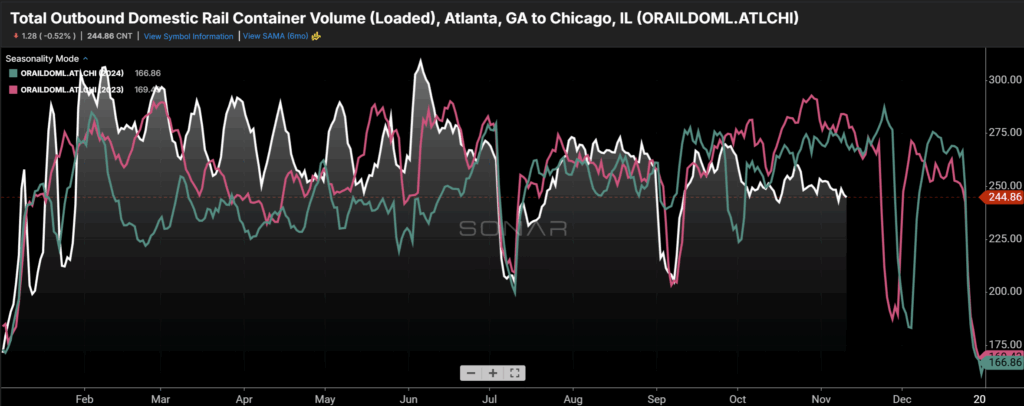
Due to a combination of weak freight demand and competitiveness with the highway, loaded domestic intermodal volume in the Atlanta to Chicago lane (white) is down 8% from 2024 levels (green). (Chart: SONAR)
Chicago to Elizabeth, NJ – Intermodal contracts provide only small savings versus truckload contracts
Intermodal and truckload contract lanes are nearly at parity in the Chicago to Elizabeth, NJ lane at $2.82/mile and $2.90/mile, respectively, when fuel surcharges are included for both modes, yielding only a 3.4% savings for intermodal. Meanwhile, for shippers willing to play the truckload spot market (green line below), rates undercut contract rates for both modes.

(Chart: SONAR)
Despite the relatively low savings rate percentage associated with domestic rail intermodal in the lane, volume has improved seasonally from around 300 containers/day in the summer to 357 containers/day in the past week. Put differently, intermodal volume is down 6% year over year versus a 34% year-over-year decline in long-haul truckload tender volume outbound from Chicago. That may suggest that service levels are solid and/or pulled-forward imports are reducing the time-sensitivity of some shipments.

Loaded domestic (orange) and international (pink) containerized intermodal volume in the Chicago to Elizabeth/Newark lane. (Chart: SONAR)