When operating minibids or short-term RFPs, or when pricing individual loads, it is important to understand the directional movement of freight trends in order to be proactive in your pricing strategy. New features are available in Batch Rate Intelligence that help users quickly identify trends and market movement. We’ll cover a couple of them here.
Outbound Tender Reject Index
The Outbound Tender Reject Index (OTRI) is a measure of the percentage of electronic tender requests for shipments that are rejected by carriers in the United States. OTRI is a leading indicator of the overall health of the freight market, as it reflects carriers’ willingness or ability to accept loads. When the OTRI is high, it indicates that carriers are rejecting a larger share of tenders, which could suggest that they are at capacity or have other options for more profitable loads. When the OTRI is low, it indicates that carriers are accepting a larger share of tenders, which could suggest that capacity is more readily available.
OTRI in Batch Rate Intelligence is mode-specific for van and reefer loads, and is at the market level. It can be easier to get a carrier to move a load from a low-OTRI to a high-OTRI market, as carriers are more willing to accept loads in markets with high demand. However, specific circumstances such as equipment compatibility, location access and market volatility can still pose challenges. Careful planning, negotiation and execution are key to securing capacity and optimizing supply chain operations.
TRAC day over day and week over week
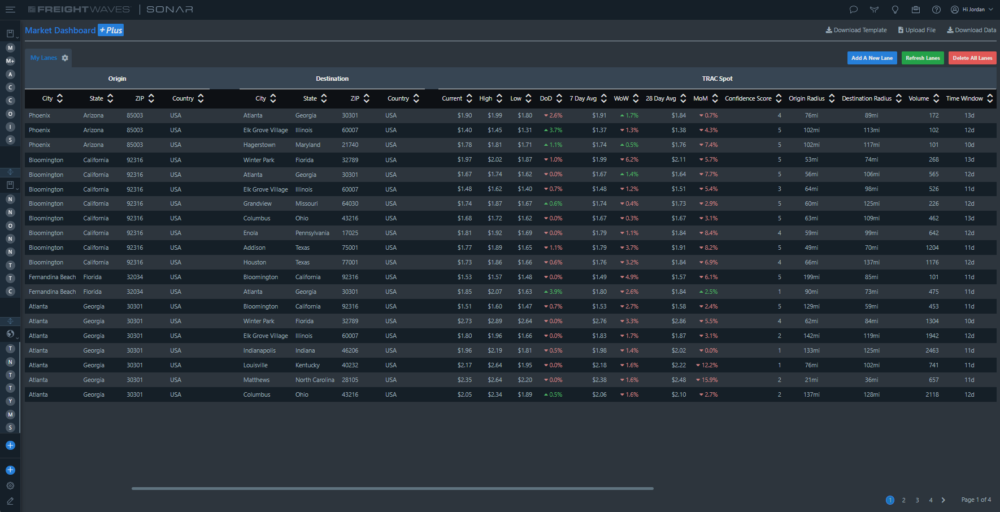
Day-over-day and week-over-week trends track the changes in TRAC spot rates, helping users gain insight into market conditions and make more informed decisions regarding pricing, capacity and shipping schedules.
By monitoring trends against the industry’s most up-to-date rates, transportation pros can adjust their pricing strategies faster than the competition. For example, if rates are trending upward, they may be able to increase their prices to take advantage of market conditions. Conversely, if rates are trending down, they may need to adjust their pricing to remain competitive.
Users can also leverage TRAC rate trends to garner insights into demand signals and identify areas to strategically adjust capacity and shipping schedules. If a shipper can hold off a period of time to save money on a decreasing lane, it may be worth it. Conversely, if a carrier sees rate trends rising, it may have negotiating power that others would not have capitalized on.
All your lanes in one place
Batch Rate Intelligence is the best place to monitor your full book of business or just your favorite lanes. Users greatly reduce time and output against bids and RFPs, and they stay more informed at a faster pace than any other logistics pricing tool can offer. As Batch Rate Intelligence continues to grow, look for more solutions that your business can’t afford to live without.