Why the same real-time freight data now informing federal transportation policy is available to every supply chain professional — see available options here.
Every month, federal agencies make decisions that ripple across the entire U.S. supply chain — trucking safety enforcement, infrastructure investment, economic research into freight demand. Historically, the data behind those decisions has lagged the market itself by weeks or months.
That’s starting to change.
The U.S. Department of Transportation has signed on to receive high-frequency freight market data directly from SONAR. The agreement puts SONAR’s real-time truckload, intermodal, ocean, and air cargo datasets in front of USDOT’s Office of the Assistant Secretary for Research and Technology, supporting the Department’s Bureau of Transportation Statistics as it modernizes how it monitors the health of the freight economy.
“Freight is the heartbeat of the U.S. economy, and policymakers shouldn’t have to wait months to take its pulse,” said Craig Fuller, founder and CEO of FreightWaves, in the announcement. “The Office of the Assistant Secretary for Research and Technology has long set the standard for transportation information, and we’re proud that SONAR’s real-time freight market data will now strengthen that work — helping build a stronger, safer, and more resilient supply chain.”
Lee White, Deputy Assistant Secretary for Research and Technology at USDOT, put it plainly: the agency needs “the most robust and current data sources” as it modernizes its own systems. SONAR was the one it chose.
What this actually means
USDOT isn’t the first sophisticated buyer to make that call, but it may be the most consequential. This is a federal agency — with every dataset in the world available to it — choosing SONAR’s high-frequency, point-of-booking market signals to understand what’s actually happening in freight, in something close to real time.
That’s a different kind of validation than a customer testimonial. It’s a statement about which data source federal regulators consider the ground truth for freight market conditions.
Which raises an obvious question for every shipper, carrier, broker, and 3PL still making decisions on stale or lagging data: if this is the standard the federal government is holding itself to, why would anyone in the industry settle for less?
SONAR for every supply chain role
The reality is that most supply chain professionals have assumed real-time market intelligence is an enterprise-only tool — something reserved for large shippers and carriers with dedicated procurement and network strategy teams.
That’s no longer the case. SONAR is built to serve every role in the freight ecosystem, at a price and format that matches how that role actually works:
Blue to Blue — $9.99/mo (iOS) Built for drivers. Real-time, lane-by-lane spot rate comparisons, right on your phone — no desktop required.
SONAR Self-Serve Quick Rates — $24.99/mo Built for office teams. Lane-level spot rates, capacity conditions, and broker guidance from your browser — no demo, no contract, no waiting.
FreightWaves SONAR Market Monitor — $199/mo Built for supply chain executives. Twenty-nine live SONAR freight indices, AI-written daily briefings, and FreightWaves news — the national market, in one screen, every morning.
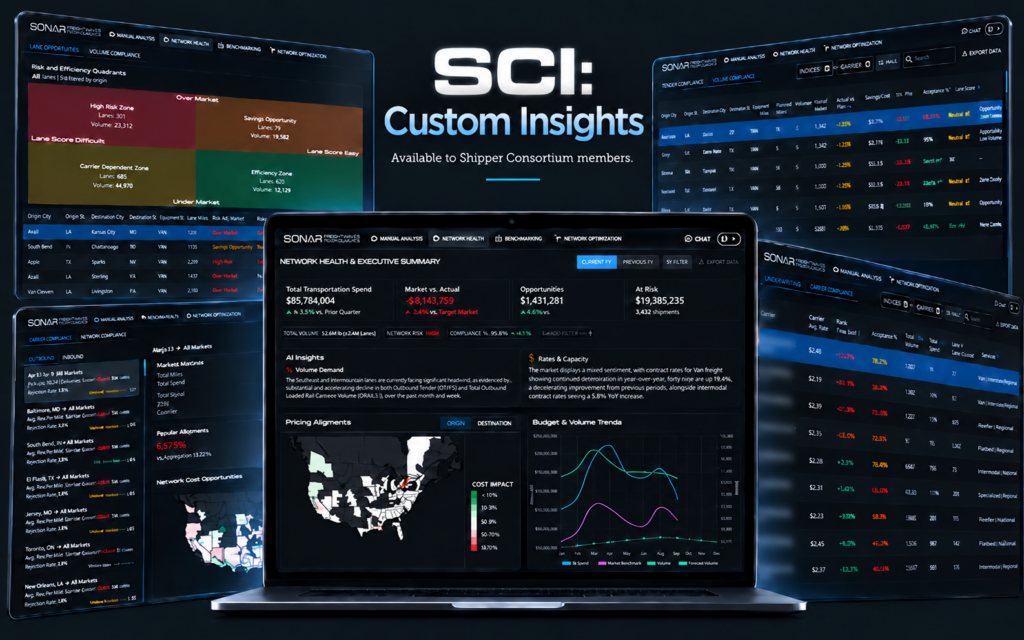
SONAR Enterprise — Custom pricing Built for organizations that need the full platform: lane-level rates, national market data, API access, multi-user licensing, custom dashboards, and dedicated support.
Four tiers. One data foundation. The same real-time signals now informing federal transportation policy, sized to fit a driver’s phone, an analyst’s desktop, an executive’s morning briefing, or an enterprise’s entire network strategy.
The bottom line
Freight moves fast, and for years the tools available to track it haven’t kept pace — especially for anyone outside the enterprise buyer’s budget. USDOT’s decision to build its own market monitoring on SONAR’s data is a signal worth paying attention to: real-time, high-frequency freight intelligence isn’t a luxury anymore. It’s becoming the baseline.
The only remaining question is which tier of it you’re using.