Rail Cargo Theft 2026: Why Organized Crews Are Robbing Freight Trains — and Why CORCA Is Stuck in the Senate
Published August 2026 · SONAR Research
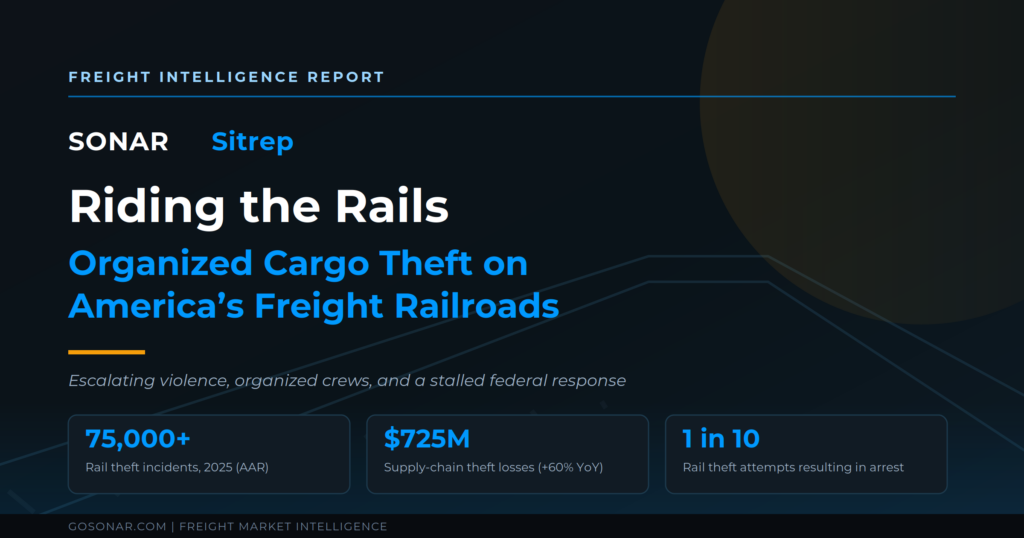
TL;DR: Major U.S. railroads reported more than 75,000 cargo theft incidents worth over $200 million in 2025 — a 50%-plus increase year-over-year — while supply-chain-wide theft losses hit $725 million, up 60%. Organized crews have opened fire on rail police twice at California’s Cajon Pass in the past year, and hit Northern Arizona’s BNSF corridor 8–12 times a month. A federal fix (the Combating Organized Retail Crime Act, or CORCA) passed the House 348-60 in May but remains stalled in the Senate Judiciary Committee. SONAR’s full Sitrep breaks down the tactics, the data, and what to watch next.
What happened at Cajon Pass, and why does it matter?
On the night of Aug. 10, 2026, BNSF Railway police confronted a group breaking into rail cars at Cajon Pass near Devore, California. When officers moved in, a suspect fired a handgun at one of them. The officer wasn’t hit; the suspects weren’t caught. It was the second shooting incident at that same choke point in less than a year — a sign that rail cargo theft, once treated as low-level trespassing, now regularly escalates into armed confrontation.
How much is rail cargo theft actually costing the supply chain?
According to the Association of American Railroads, major U.S. railroads reported more than 75,000 theft incidents in 2025, worth over $200 million in losses — a 50%-plus increase year-over-year. Zoomed out across the full supply chain, Verisk CargoNet estimated $725 million in total theft losses in 2025, up 60% from the prior year, even though the number of reported incidents rose only 18%. That gap is the real story: organized crews aren’t stealing more often, they’re stealing smarter — targeting fewer, higher-value loads.
Where are organized crews hitting freight trains the hardest?
Two corridors account for a disproportionate share of incidents:
- Cajon Pass, California — a mountain grade where trains slow down, creating a recurring target for both opportunistic and organized crews.
- The BNSF Transcon corridor across Northern Arizona (Winslow, Ash Fork, Seligman, Williams) — where Coconino County investigators say train burglaries happen 8 to 12 times a month, carried out by both independent crews and coordinated networks.
Court records in one Arizona case describe a coordinator — charged as “El Pollo” — who recruited crews specifically to travel to the state and break into freight trains, netting 2,500 pairs of unreleased Nike shoes and 1,000 boxes of gaming headsets in a single series of thefts.
Why do so few rail theft arrests happen?
Only about 1 in 10 rail theft attempts leads to an arrest, according to AAR. Cases are often multi-jurisdictional and sometimes transnational, which spreads investigations thin across local, state and federal agencies with no single owner. Railroads say industry security spending — drones, thermal imaging, AI-flagged cameras, reinforced fencing — has helped, but can’t substitute for coordinated federal enforcement.
What is CORCA, and why hasn’t it passed?
The Combating Organized Retail Crime Act (CORCA, H.R. 2853) would strengthen federal statutes against organized theft networks, expand money laundering and asset forfeiture authorities, and establish a national coordination center inside Homeland Security Investigations. It passed the House 348-60 in May 2026 and has backing from more than 200 companies and trade groups, including AAR, BNSF, and the American Trucking Associations. It has sat in the Senate Judiciary Committee since the day after House passage. Separately, a coalition has also had to press the Department of Justice just to implement cargo-theft enforcement funding Congress already approved under the FY2026 appropriations act — DOJ has missed its own statutory deadlines on that front.
Where can I access this Sitrep and others like it?
Enterprise subscribers can find this Sitrep and all other SONAR Sitreps under the Research section of the SONAR Platform.
Individual Sitreps are also available as self-serve research unlocks through FreightWaves Market Monitor at getfreightdata.com, with subscription plans starting at $199/month.
FAQ: Rail Cargo Theft and CORCA
How much did rail cargo theft cost in 2025? Major U.S. railroads reported more than 75,000 theft incidents worth over $200 million in losses in 2025, a 50%-plus increase from 2024, according to the Association of American Railroads.
What is the CORCA bill? CORCA (the Combating Organized Retail Crime Act, H.R. 2853) is a bipartisan federal bill that would strengthen law enforcement tools against organized theft networks, create a national coordination center within Homeland Security Investigations, and fund grants and training for state and local agencies. It passed the House 348-60 in May 2026 and is currently stalled in the Senate Judiciary Committee.
What percentage of rail theft attempts result in an arrest? Only about 1 in 10 rail theft attempts leads to an arrest, according to AAR estimates, largely because organized theft cases frequently span multiple jurisdictions.
Which rail corridors see the most cargo theft? Cajon Pass in California and the BNSF Transcon corridor across Northern Arizona (Winslow, Ash Fork, Seligman, Williams) are among the most frequently targeted, both due to choke-point geography that slows trains and limited law-enforcement response coverage in remote areas.
What are railroads doing to combat cargo theft? BNSF and Union Pacific have invested tens of millions of dollars in drone surveillance, thermal imaging, AI-flagged security cameras, and reinforced fencing. Union Pacific alone has spent more than $30 million on security since January 2023. Railroads say this industry investment isn’t sufficient on its own and are pushing for federal legislative and enforcement support.
This Sitrep is based on FreightWaves reporting, Association of American Railroads data, Verisk CargoNet loss estimates, and court and law-enforcement records. Request a SONAR demo to see how SONAR tracks the freight market signals behind stories like this one.