There may have never been a better time for shippers to take a fresh look at their lanes to see if they could use more rail intermodal. Service levels are adequate, containers are available, and competition between domestic intermodal providers is keeping rates relatively in check.
Shippers are responding by using intermodal more heavily, and that is showing up in SONAR volume data. Loaded containerized domestic intermodal volume (ORAILDOML.USA) stands out for being up 13% year over year in the first week of June, using a seven-day moving average. Volume accelerated in March to near record levels for that time of the year, and further strength in the second quarter is outside of seasonal norms – current volume is usually reserved for the fourth quarter (October has historically been the peak month). I consider domestic intermodal volume to be one proxy that illustrates whether shippers are finding value in intermodal service levels, since shippers have modal optionality in many cases.
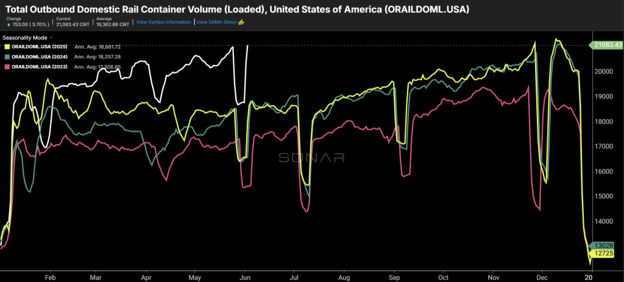
Loaded containerized domestic intermodal volume is handily outperforming recent years’ first half volume and is roughly in line with the last two fall seasonal peaks. (Chart: SONAR)
In addition, the tightening truckload market has clearly increased the relative savings that can be achieved by using rail intermodal. In SONAR, the intermodal savings rate for major outbound LA lanes is 30%, up from about 15% this time last year (IMCSI.TRANSCON). Meanwhile, the savings rate on dense “local east lanes” is 19% (IMCSI.LOCALEAST), up from about 12% last year. Fuel is included for both modes in those “savings rate” comparisons, which explains a portion of the increase. It’s also a function of changes in intermodal rates lagging truckload, as they have historically. Domestic intermodal carriers have the capacity to take on incremental volume following their investments in containers during the past few years. That has led to a competitive marketplace in intermodal, especially in long-haul transcontinental lanes, which are relatively unaffected by the truckload market. In addition, some shippers may be using intermodal as a hedge against the tight truckload market for freight they move in lanes that are competitive across modes.
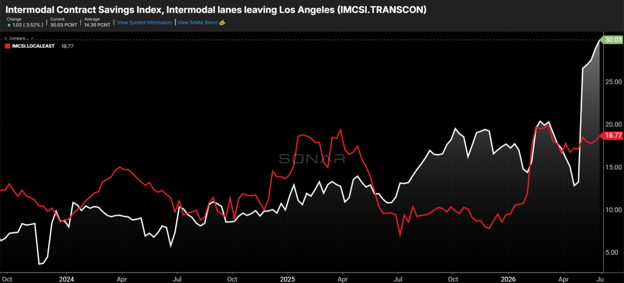
The savings that can be realized using intermodal over truckload has increased in the past year, especially for transcontinental lanes leaving Los Angeles (white line). The Local East savings rate is shown in red. (Chart: SONAR)
The main risks I see to these trends continuing are the consumer, inventory levels, and rail service. Intermodal freight is weighted toward retail and CPG, areas that are impacted by inflationary pressure and GLP-1 drugs. This year, shippers have generally operated with leaner inventories in an attempt to avoid oversupplies like 2022 and in response to elevated inventory carrying costs. If shippers overdo that, it could lead to shipments becoming more time sensitive, which would shift volume back to the faster mode. Rail service levels have been strong for the past couple of years, and there is lots of pressure to keep them that way with the U.S. Surface Transportation Board rolling out additional requirements for reporting. But, it remains to be seen whether service levels hold up if peak intermodal volumes set new records, which seems possible, or even likely, based on intermodal volume in the first half. I’m less concerned that a resolution to the Iran conflict would reduce fuel prices, which would reduce the relative advantage of intermodal. In my observation, the use of intermodal tends to be sticky, provided that rail service levels hold up.
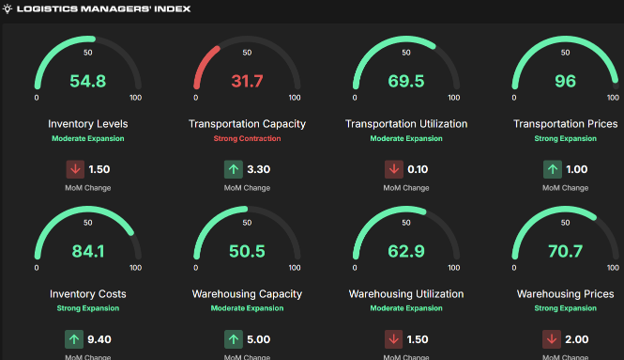
Expansion of inventory costs and warehousing prices stand out in the latest LMI. That encourages shippers to hold less inventory and can lead to more time-sensitive shipments, discouraging the use of rail intermodal. (Chart: SONAR Executive Dashboard)