Last week, DOT Secretary Sean Duffy pulled $73.5 million in federal highway funding from New York state — the latest escalation in what has become one of the most consequential regulatory confrontations in trucking in a generation. The money is gone because New York refused to revoke commercially licensed drivers who were never legally eligible to hold those licenses in the first place. But to understand why this matters beyond the politics, you need to understand what happened to the non-domiciled CDL program over the past decade — and where the crackdown is taking the industry.
Background: What Is a Non-Domiciled CDL?
A non-domiciled commercial driver’s license was originally designed as a practical accommodation: it allowed a driver who was domiciled in one state to obtain a CDL in another. Over time, the program expanded to cover foreign nationals — people without U.S. residency — who needed a commercial license to legally drive big rigs here. The concept wasn’t inherently problematic. The execution was.
Non-domiciled CDLs were originally introduced in 2017 to provide flexibility for drivers who resided in one state but needed to obtain a license in another. Over time, this licensing category expanded to include non-U.S. residents, sometimes without proper work permits — an evolution that went beyond the original intent. FreightWaves
The abuse came from the states themselves. FMCSA audits from 2024 to 2025 identified license inconsistencies at state driver licensing agencies, including unverified immigration status, acceptance of expired foreign documents, and limited checks of prior driving records. WWEX The failure wasn’t a fringe problem. It was systemic.
The New York Numbers
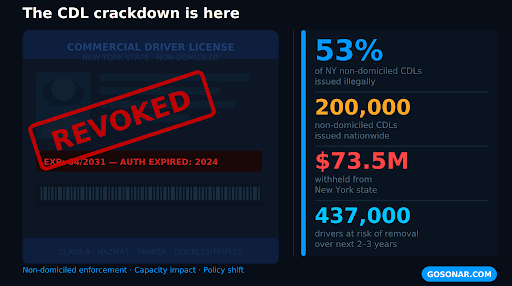
A federal audit exposed a 53% failure rate in the records sampled from New York’s DMV, indicating a total collapse in the administration of New York’s non-domiciled CDL program. US Department of Transportation Specifically, the DMV’s systems defaulted to issuing eight-year licenses to foreign drivers for non-REAL ID licenses, regardless of when their legal status expired, and the state issued commercial licenses to foreign drivers without providing any evidence that it had verified their current lawful presence in the United States. GovPing
In total, New York issued 32,000 CDLs to foreign drivers. At the 53% failure rate, that’s roughly 17,000 improperly issued commercial licenses. FMCSA flagged this in December 2025 and gave the state 30 days to get into compliance. New York refused. In the letter sent by FMCSA to Governor Hochul and Motor Vehicles Commissioner Mark Schroeder, FMCSA Administrator Barrs said New York’s response was that the state “continues to dispute the legal and procedural merits of FMCSA’s determination of noncompliance” and “declined to take corrective action.” Barrs replied directly: “New York’s arguments are without merit. States must require proof of lawful presence and must ensure the expiration date of the CDL does not exceed the expiration date stated on the driver’s lawful presence documents. This is not a new requirement.” freightwaves
On April 16, Duffy dropped the hammer: $73,502,543 withheld — 4% of New York’s National Highway Performance Program and Surface Transportation Block Grant funds — with additional tranches threatened if the state remains out of compliance.
New York joins California as the only states to actually lose highway funding as a result of non-domiciled CDL issues, though at least 28 other states and jurisdictions were similarly warned — all of which have since fallen in line. Overdrive
The Industry Response: Playing It Down the Middle
Not everyone in the trucking world is cheering the enforcement action without qualification. The Trucking Association of New York called the decision “deeply concerning” and noted that the loss in funding will impact infrastructure projects. The association acknowledged that “standards must be consistently enforced and the integrity of the CDL program must be upheld,” while also asserting that “New York’s CDL framework already requires compliance with strict federal standards, including verified work authorization, completion of entry-level driver training, and adherence to safety regulations.” freightwaves It’s a careful hedge — neither defending the state’s conduct outright nor endorsing the federal penalty — that reflects the genuine tension between regulatory compliance and the industry’s reliance on this portion of the driver workforce.
This Is a National Story, Not a New York Story
The full scope of the crackdown dwarfs the New York headline. The nationwide audit uncovered systemic non-compliance across several states — the worst and most egregious in California. More than 25% of non-domiciled CDLs reviewed in California were improperly issued, including licenses extended years beyond drivers’ lawful presence in the U.S. US Department of Transportation Illinois was found to have nearly 1-in-5 licenses issued illegally US Department of Transportation, and Colorado, Pennsylvania, South Dakota, Texas, and Washington were also identified as states with licensing patterns inconsistent with federal regulations. US Department of Transportation
The scale nationally: at least 200,000 non-domiciled CDLs have been issued nationwide, with particularly high concentrations in states like California, Texas, and Florida — states that support major agricultural, port, construction, and logistics corridors. FreightWaves
Fatal Crashes Accelerated the Timeline
The policy debate became a safety emergency in 2025. At least 17 fatal crashes and 30 deaths in 2025 alone were caused by non-domiciled drivers who will now be ineligible to get a license under the new rule. FMCSA One of those crashes — a California multi-car pileup in June 2024 — critically injured five-year-old Dalilah Coleman and has become the namesake for pending federal legislation that would make the restrictions permanent law.
The core safety problem: while U.S. drivers are subject to strict checks through national databases for past violations — DUIs, reckless driving, or crash involvement — states lack the ability to access the driving records of foreigners, creating a loophole that allowed individuals with dangerous driving histories to obtain a trucking license simply by presenting an Employment Authorization Document. FMCSA
The FMCSA Final Rule: What Changed on March 16
On March 16, 2026, a new FMCSA Final Rule took effect that dramatically narrows who qualifies for a non-domiciled CDL. The rule limits eligibility to foreign-domiciled individuals who hold specific, verifiable employment-based nonimmigrant status — specifically H-2A agricultural workers, H-2B seasonal non-agricultural workers, and E-2 treaty investors. DACA recipients, refugees, asylees, TPS holders, and most other visa categories are excluded. FreightWaves
The consequences of that exclusion are enormous. FMCSA estimates that 97% of the current 200,000 non-domiciled CDL holders nationwide will not be able to satisfy the new requirements under the Final Rule, assuming it survives legal challenge. FreightWaves
The Pushback: Courts and Affected Drivers
The enforcement actions are already drawing legal challenges. A lawsuit filed in U.S. District Court for the Southern District of Florida — brought by 19 individuals identified only by their initials, all domiciled in a foreign country but operating commercial vehicles in Florida — argues that the combined effect of federal and state actions has been “catastrophic”: plaintiffs cannot work, cannot earn a living, face financial ruin, and have been “deprived of vested property and liberty interests without due process of law — all without any individualized determination of fault, misconduct, or safety concern.” freightwaves Similar litigation has been filed in California. Whether any of these challenges succeed in staying the Final Rule remains the critical legal variable in how fast this capacity reduction actually materializes.
The Capacity Question: How Much Does This Tighten the Market?
This is where it gets directly relevant to every shipper, broker, and carrier watching freight rates. The honest answer is that nobody knows exactly when the capacity effect arrives — but the direction is unambiguous.
The non-domiciled CDL surge has been identified as a major contributor to the ongoing freight recession. Over 200,000 new drivers entering the market since 2019 created capacity that depressed rates and extended the downturn beyond what fundamentals alone would suggest. FreightWaves That is not a minor footnote — it’s one of the primary reasons the freight recession lasted as long as it did.
Now the math runs in reverse. J.B. Hunt’s analysis suggests that between non-domiciled CDL restrictions and English language proficiency enforcement, the U.S. could see between 214,000 and 437,000 drivers removed from the workforce over the next two to three years. FreightWaves That range is wide because the timing is uncertain — existing licenses are grandfathered until renewal, which softens the immediate shock but makes a prolonged tightening almost inevitable.
The DOT acknowledged the market effect directly in its own rulemaking, stating that FMCSA anticipates the market will respond to the change in capacity as it has in the past, with rates adjusting and drivers and carriers entering the market where needed. FreightWaves That is the federal government, in a regulatory filing, saying freight rates are going up.
The lanes most exposed: produce, port drayage, and seasonal agriculture — where non-domiciled drivers represent a meaningful portion of the CDL workforce — are at the highest risk of capacity volatility, rate fluctuations, and service disruption. WWEX
The Bigger Policy Shift: Dalilah’s Law and What Comes Next
The regulatory story doesn’t end with the March 16 rule. Dalilah’s Law, currently before the Senate, goes further: it makes the non-domiciled CDL restrictions permanent law rather than a regulation a future administration could reverse, requires states to audit all current foreign-domiciled licenses within one year and revoke any that don’t comply, and adds a new requirement for every CDL holder in America — all knowledge and skills tests must be conducted only in English. Non-compliant states could lose up to 8% — then 12% — of their federal highway funding. FreightWaves
The English proficiency piece deserves particular attention. FMCSA has already issued guidance placing CMV drivers who fail English language proficiency requirements out of service immediately. Combined with Dalilah’s Law, this extends the compliance burden well beyond the non-domiciled population to any driver who cannot demonstrate English fluency — a significant expansion of the policy’s reach into the broader driver workforce.
The funding penalty mechanism is also worth watching. New York’s $73.5 million represented 4% of its highway program allocation. Dalilah’s Law contemplates penalties starting at 8% and escalating to 12% for continued non-compliance — nearly triple the current threshold. For states with large highway programs, that is an existential enforcement lever.
What This Means for Freight Markets
The policy arc is now clear. The non-domiciled CDL program fueled a capacity surge that depressed rates and prolonged a historic freight recession. The correction is underway — through state-level revocations, the FMCSA Final Rule, pending Congressional action, and funding penalties that give the federal government genuine leverage over non-compliant states. The capacity bleed will be gradual, not sudden. But the direction is one-way.
For carriers, the message is straightforward: driver qualification file audits need to happen now. If FMCSA identifies an invalid CDL in active service, the driver may be immediately removed — and in severe cases, carriers can receive acute violation status, limiting operations across their entire fleet. WWEX That is not a compliance technicality. That is an operational risk that can shut down a carrier.
For shippers and brokers, the exposure is in the lanes that have been running on non-domiciled capacity: drayage corridors out of Los Angeles, Long Beach, and New York; produce lanes out of the Central Valley and Texas border crossings; seasonal agriculture freight in the Southeast and Pacific Northwest. Those are the lanes where capacity exits first and rates move hardest.
The SONAR indices to watch: OTRI (outbound tender rejection index) and STRIF (flatbed rejection rate) will be the first places this shows up in the data as tightening materializes. If the J.B. Hunt projection of 214,000–437,000 drivers removed proves accurate, the market impact won’t be a ripple. It will be a structural reset.
To read a full Sitrep on the topic, click here.
Check out SONAR’s new Carrier Safety Dashboard here.
For real-time freight market intelligence on capacity and rate signals, visit GoSONAR.com.