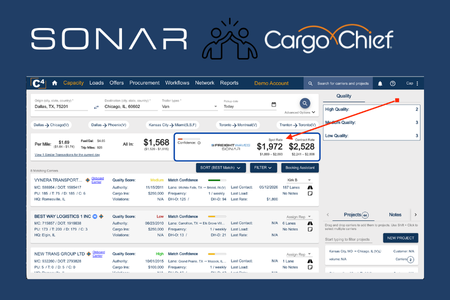
Transportation benchmarking has become a standard part of procurement, budgeting, and carrier negotiations. Most transportation teams can quickly identify the low, average, and high market rates for a lane and use those benchmarks to evaluate carrier pricing.
The challenge is that benchmarking alone doesn’t tell you where your lane should actually be priced.
Two lanes may have identical average market rates, yet one may support aggressive cost reductions while the other is facing increasing pricing pressure. The difference isn’t the benchmark itself, it’s the market conditions behind it.
By combining SONAR’s contract pricing bands with lane score, tender rejection trends (STRI), and freight volume trends (STVI), transportation teams can move beyond simple benchmarking and develop a more strategic approach to lane pricing.
Benchmarking Provides the Range
Most benchmark datasets provide three reference points:
- Low Market Rate
- Average Market Rate
- High Market Rate
These benchmarks establish the boundaries of the market and help answer an important question: What are others paying?
What they don’t answer is where your lane should fall within that range.
Targeting the market low on every lane can create unnecessary service risk, while consistently paying near the market high can leave savings opportunities on the table. The goal is not simply to know the market rate but to determine where your pricing should be positioned relative to current market conditions.
Understanding Market Positioning
Three data points can help determine where a lane should be positioned within the benchmark range:
Lane Score
Lane score measures the underlying structure of a lane.
- Above 60: Generally favorable for shippers
- 40-60: Balanced market conditions
- Below 40: Structurally challenging lane
Lane score helps establish how much pricing leverage a shipper is likely to have before current market conditions are considered.
Tender Rejection Trend (STRI)
STRI measures changes in carrier willingness to accept freight.
- STRI ↓ = Capacity loosening
- STRI ↑ = Capacity tightening
Freight Volume Trend (STVI)
STVI measures changes in freight demand.
- STVI ↓ = Demand softening
- STVI ↑ = Demand increasing
Together, these indicators provide insight into whether market conditions are becoming more favorable or less favorable for shippers.
Turning Market Data Into Pricing Guidance
Rather than treating benchmark rates as a single target, transportation teams can use market conditions to determine where within the benchmark range a lane should be priced.
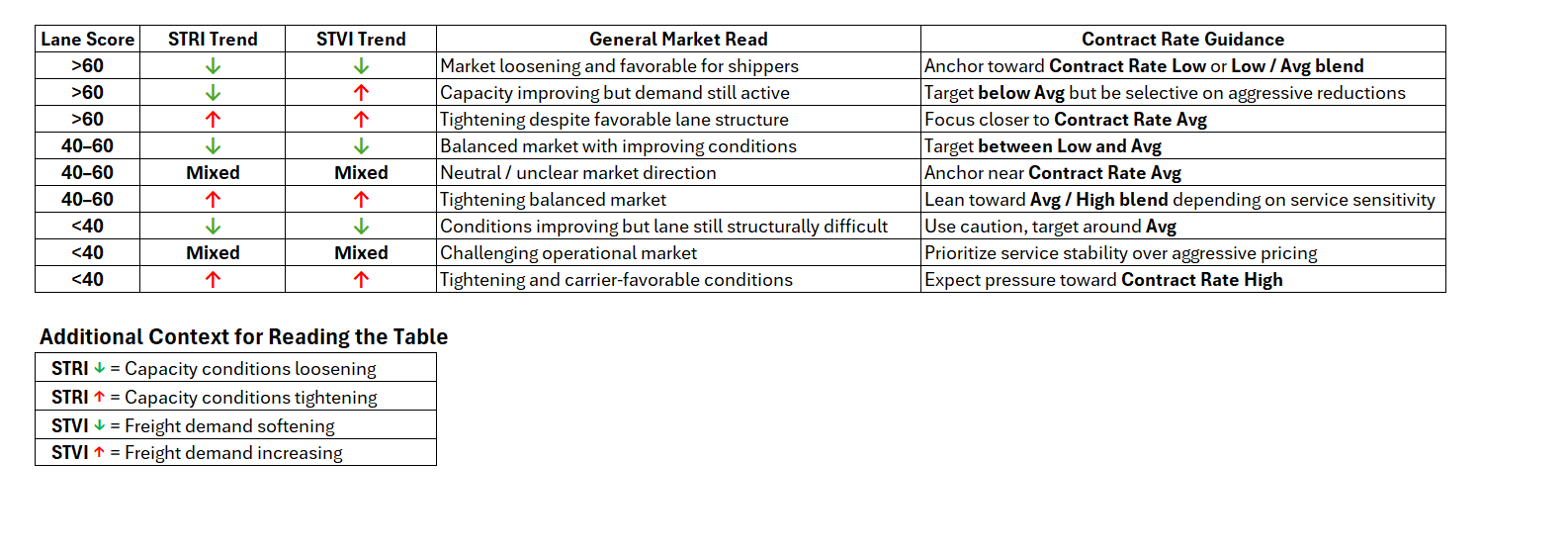
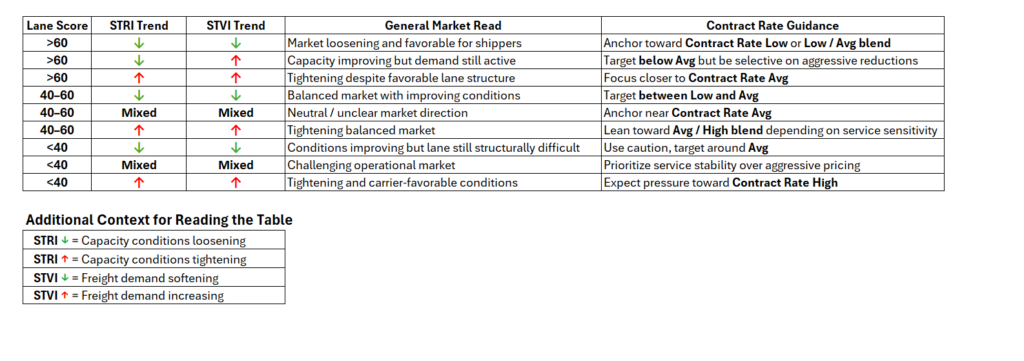
For example, a lane with a lane score above 60 and declining rejection and volume trends may support pricing closer to the low end of the market range. Capacity is loosening, demand is softening, and market leverage is shifting toward shippers.
Conversely, a lane with a low lane score and rising rejection and volume trends may warrant pricing closer to the high end of the range. In these situations, tightening capacity and increasing demand can create upward pricing pressure even when broader market conditions remain stable.
Balanced lanes with mixed signals often justify anchoring closer to the market average until a clearer trend emerges.
The key is recognizing that not every lane should be priced the same simply because the benchmark averages are similar.
Moving From Benchmarking to Strategy
Benchmarking is an important first step, but it should not be the final step.
Benchmarking tells you what the market is paying today. Market intelligence helps determine where your lane should be positioned within that market.
By combining pricing benchmarks with lane score, tender rejections, and freight volume trends, transportation teams can make more informed procurement decisions, build more accurate transportation budgets, and enter carrier negotiations with a clearer understanding of market leverage.
The most successful transportation organizations don’t simply ask, “What is the market rate?”
They ask, “Given current market conditions, where should this lane be priced within the market range?”
Tune into Freightonomics as Zach Strickland breaks down what the current increase in spot rates means for brokers and shippers, and how they may need to change the way they use rate benchmarks.