When it comes to freight procurement, benchmarks are one of the most powerful tools a shipper can use. They provide clarity, objectivity, and confidence in a market that’s often clouded by anecdotal carrier feedback or outdated rate sheets.
But here’s the reality: while SONAR benchmarks are built on some of the densest and most diverse freight datasets available, making them among the most reliable signals in the industry, no benchmark can fully capture the unique dynamics of each shipper’s individual network.
That’s why the smartest shippers treat benchmarks as guidance, not gospel.
Benchmarks Provide a Strong Foundation
SONAR benchmarks give shippers a trusted baseline. They strip away noise and deliver a statistically confident view of what the market is paying across thousands of lanes, modes, and carriers.
This market-level perspective is invaluable: it helps shippers validate routing guide performance, frame conversations with carriers, and align with finance and leadership on realistic budget expectations.
In short, benchmarks provide the foundation that helps you stay oriented in a fast-changing freight landscape..
Every Network Has Its Own Story
At the same time, no two shipper networks are identical. Your lane mix, facility footprint, seasonal demand, and compliance requirements all introduce variables that don’t show up in market averages.
For example:
- A shipper moving heavy beverage freight into the Northeast may face chronic tightness and dwell challenges that push rates above market averages.
- A retailer importing from the West Coast may benefit from dense volumes and attractive backhaul opportunities that let them run below benchmark.
- A manufacturer with highly irregular shipping patterns may struggle to achieve benchmark rates because carriers price in uncertainty.
- A shipper that requires strict drop-trailer programs at multiple facilities may incur higher costs than benchmarks suggest, since not all carriers can support those requirements.
- A seasonal business that peaks in Q4 may pay premiums well above average benchmarks, while off-peak periods trend far below them.
These internal characteristics don’t mean the benchmark is “wrong,” they mean your network’s story is unique.
Benchmarks + Internal Data = Real Insight
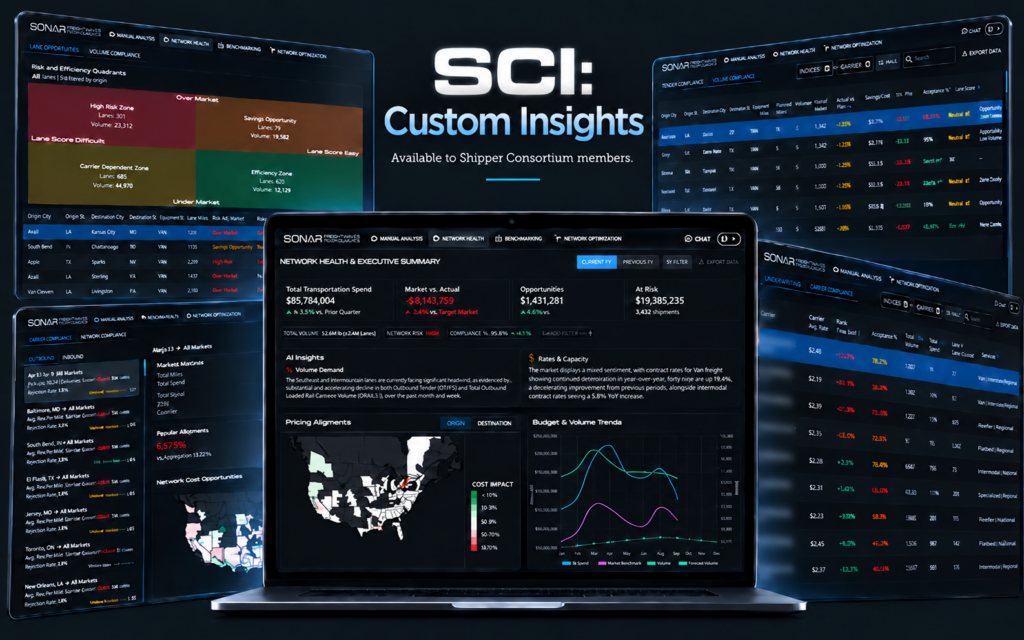
The real power comes from layering SONAR benchmarks with your own data: routing guide performance, tender acceptance and rejection, service metrics, and carrier scorecards.
This blended view allows you to ask better questions:
- Is this carrier quoting above market because of service value, or because they’re underperforming?
- Are my rates trending higher due to market pressure, or internal inefficiencies like facility dwell or mode mix?
- Do my drop trailer pool requirements add costs that won’t show up in a pure benchmark comparison?
- Is inconsistent volume from my side driving higher rates, even if the market looks flat?
- Are my on-time delivery expectations leading me to pay a premium for carriers who can consistently meet them?
By using benchmarks as the external anchor and your data as the internal lens, you can move beyond raw numbers to actionable insights.
Guidance, Not Gospel
Market benchmarks should drive confidence and credibility in your freight strategy, but they shouldn’t dictate it.
The most resilient procurement strategies strike a balance: benchmarks frame the market, while your network realities define what “fair and sustainable” looks like for you.
Final Takeaway
SONAR benchmarks deliver the high-confidence market view every shipper needs. But your network’s unique characteristics, freight mix, lanes, and service expectations provide the critical context.
Think of benchmarks as the compass. They point you in the right direction. But it’s your network that ultimately determines the path forward.
To request a demo of SONAR’s Supply Chain Intelligence tool, click here.