Meet the new year, same as the old year?
The factors driving the tight freight market seem to be sticking around forever, like your in-laws at Christmas. The labor shortage, the semiconductor shortage, the elevated consumer goods spending, and the congestion at the ports – none seem to be changing much. Improved railway fluidity is one of the few areas where transportation networks are improving, but even in that mode, terminal congestion remains rampant.
As we approach the end of the year, shippers are in the unenviable position of having to put freight out for bid in a carriers’ market while budgeting for further-inflationary 2022 transportation costs on top of rampant inflation in virtually all of their other costs (labor, materials, packaging, energy, etc.) at the same time.
Meanwhile, shippers face the challenge of managing their day-to-day transportation networks during a period of unprecedented supply chain disruption.
Either one would be a challenge, but performing both at the same time presents additional challenges in a carrier’s market. For instance, if shippers attempt to drive a hard bargain in a bid process, it may impair carriers’ motivation to accept their tendered loads.
In preparation for next year’s bid season, and for purposes of managing day-to-day carrier networks, we first recommend evaluating the performance of your current carriers.
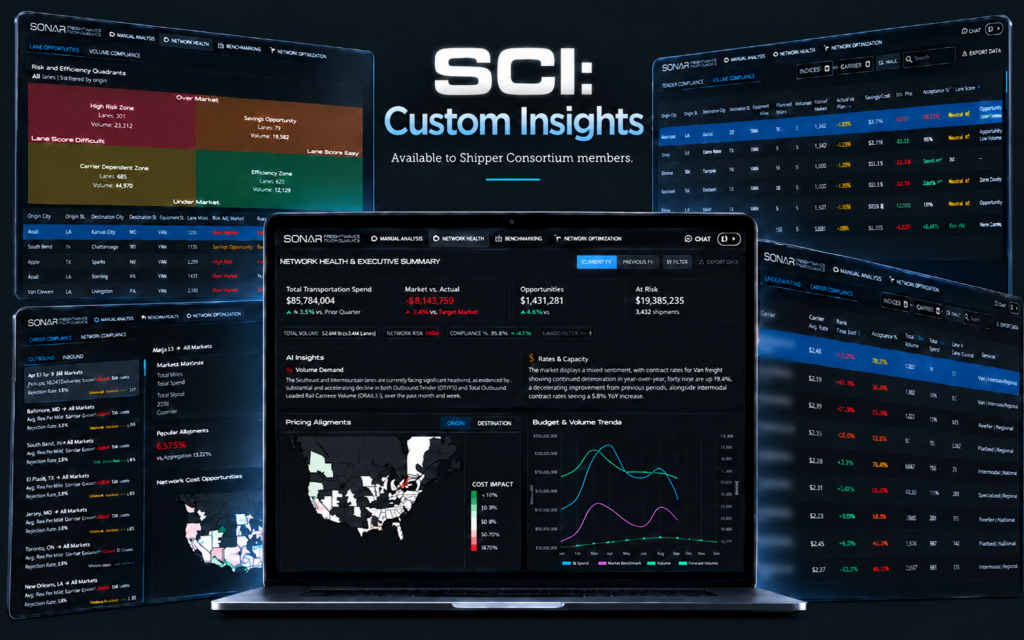
To do that, we recommend using the SONAR Supply Chain Intelligence tool to determine:
- Whether your carriers are charging rates in line with the market. SONAR SCI can be used to benchmark your rates against what other shippers in your industry are paying in the same lanes.
- Understand whether you are getting the service you are paying for. Use SONAR to see how often carriers are rejecting loads with similar characteristics to yours.
That analysis should help you to determine which carriers you want to solicit bids from.
From there, we recommend using a variety of data sets in SONAR to help quantify the degree of inflation or deflation in rates you should expect for the freight you are putting out to bid. Those SONAR data sets include:
- National contract rate data
- Tender rejection rates by market
- Historical and predicted spot rates by lane
- Lane and market scoring data that tell shippers how difficult a lane or market will be to cover