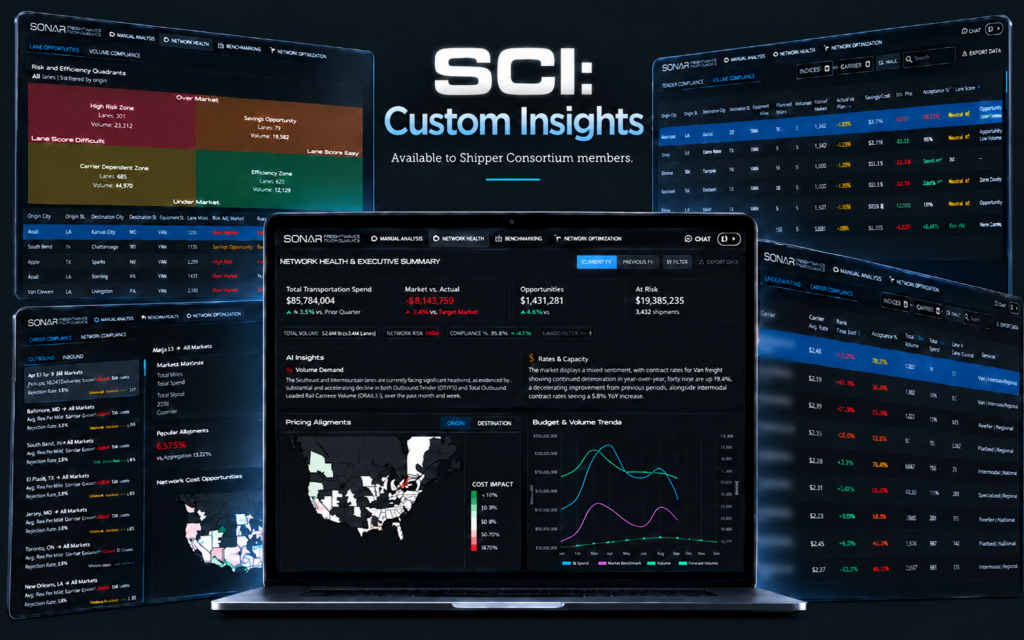
FreightWaves SONAR Supply Chain Intelligence (SCI) platform is designed to evaluate the effectiveness and efficiency of a shipper’s freight spend by:
1. Benchmarking shippers’ current or target rates to the market or industry peer group
2. Showing the lanes where shippers have the most negotiating leverage
3. Showing shippers where they are most at risk of their load not being covered
While data that shows shippers where their rates are relative to the market is most obviously useful in negotiations, it is just as important in managing day-to-day operations.
When tendering loads to carriers in a particular lane, it is important for shippers to know not only what percentage of similar tendered loads are currently being rejected by carriers, but also whether their tenders are more or less likely to be rejected by carriers than most other shippers’ loads.
During the process of establishing contract rates, shippers are strategic about where their rates stand relative to the market. For instance, they may make the strategic decision to set rates that are very competitive (attractive to carriers so tenders are less likely to be rejected) in their most mission-critical lanes where the negotiating power is typically in carriers’ favor.
Meanwhile, shippers may bid very aggressively (rates less attractive to carriers) in lanes where shipments are generally less time-sensitive and in lanes where the negotiating leverage is typically in shippers’ favor since there are ample transportation alternatives.
But, as we have seen, especially over the past two years, market conditions change quickly with trends in local freight markets that diverge sharply from historical norms.
After tender rejection rates move in response to volatility in market conditions, contract rates typically follow. As a result, shippers may find that their rates are stale, relative to when contracts were drafted, often varying widely by freight market or lane.
Shippers should continually monitor where their contract rates stand relative to the market so they know where loads are likely to fall through the routing guide and can proactively allocate resources to have contingencies in place (such as having routing guides in order) in the key lanes. That can help shippers mitigate the risk of having to pay elevated spot rates. That is particularly an issue in a rising freight rate environment and/or when shippers’ rates are priced below the market.
Just as importantly, loosening freight market conditions can create a situation in which shippers are overpaying. That should serve as a heads-up to shippers that they may want to be more aggressive and re-bid their freight earlier than usual.