Key SONAR indices sideways with prior week
This week’s SONAR Pricing Power Index (PPI): 40 – The market slightly favors shippers, in general. That rating is unchanged from the prior report.
Three-month SONAR Pricing Power Index Outlook: 50 – The market may be in balance in three months, which will be just before the holidays and a crunch time for trucking. That rating is unchanged from the previous report.
Freight demand stabilizes following Labor Day
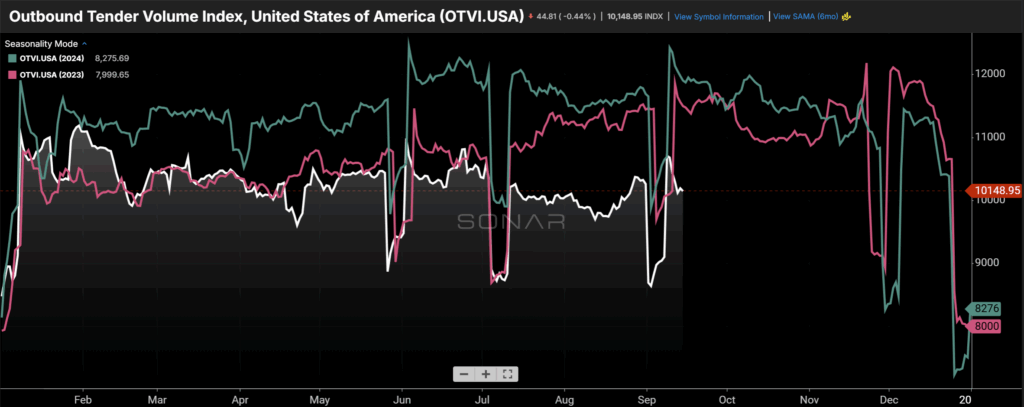
Freight demand continues to hold the market back from tightening. While the increase in tender volume in the second half of August was encouraging (up about 6.5% ahead of Labor Day, whereas a 2% increase would have been more typical), tender volume remains sharply below September levels of the past two years. Overall tender volume is down 15.5% year over year.

A comprehensive measure of freight demand, the Outbound Tender Volume Index is shown for 2023, 2024, and 2025 in pink, green, and white, respectively. (Chart: SONAR)
Long-haul truckload volume outbound from Los Angeles and Houston was a major driver of the increase in tender volume ahead of Labor Day, which, as I highlighted in the last report, was not driven by a shift away from rail intermodal. Outbound Houston volume has since retreated while outbound LA volume has remained robust, suggesting that shippers are not finished moving inventory from upstream to downstream locations closer to points of consumption.
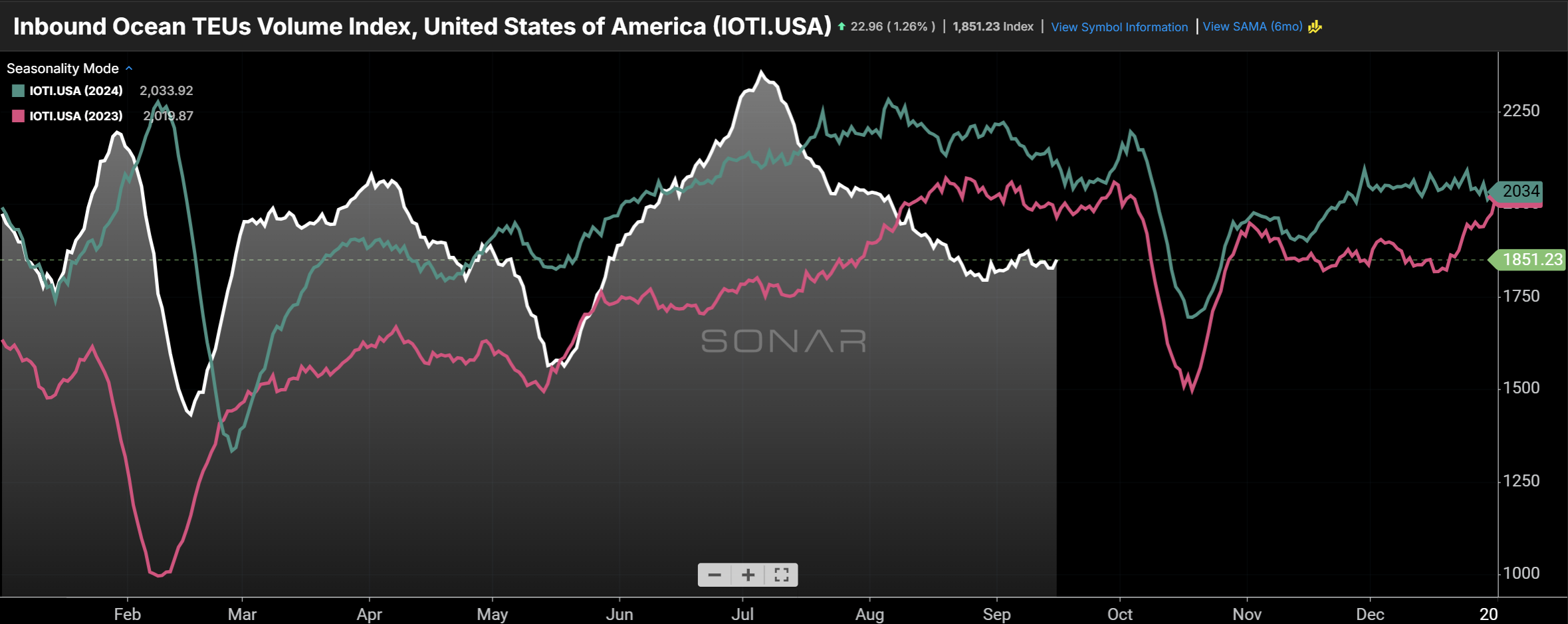
Maritime bookings of US imports taken at the point of origin for 2023, 2024, and 2025 in pink, green, and white, respectively. (Chart: SONAR)
Weak import volume in the fourth quarter could inhibit a full volume recovery this fall, which, in turn, could lead to less pronounced volume and tender rejection peaks in the fourth quarter than are typical seasonally. The above chart shows ocean bookings of containerized US imports taken at the point of overseas origin. The good news is that it stabilized and is 2% above the August low. However, containerized imports are down 15% year over year in the past week, which leads me to expect lackluster port activity in the fourth quarter.
Tender rejection rates settle between 5% and 6%
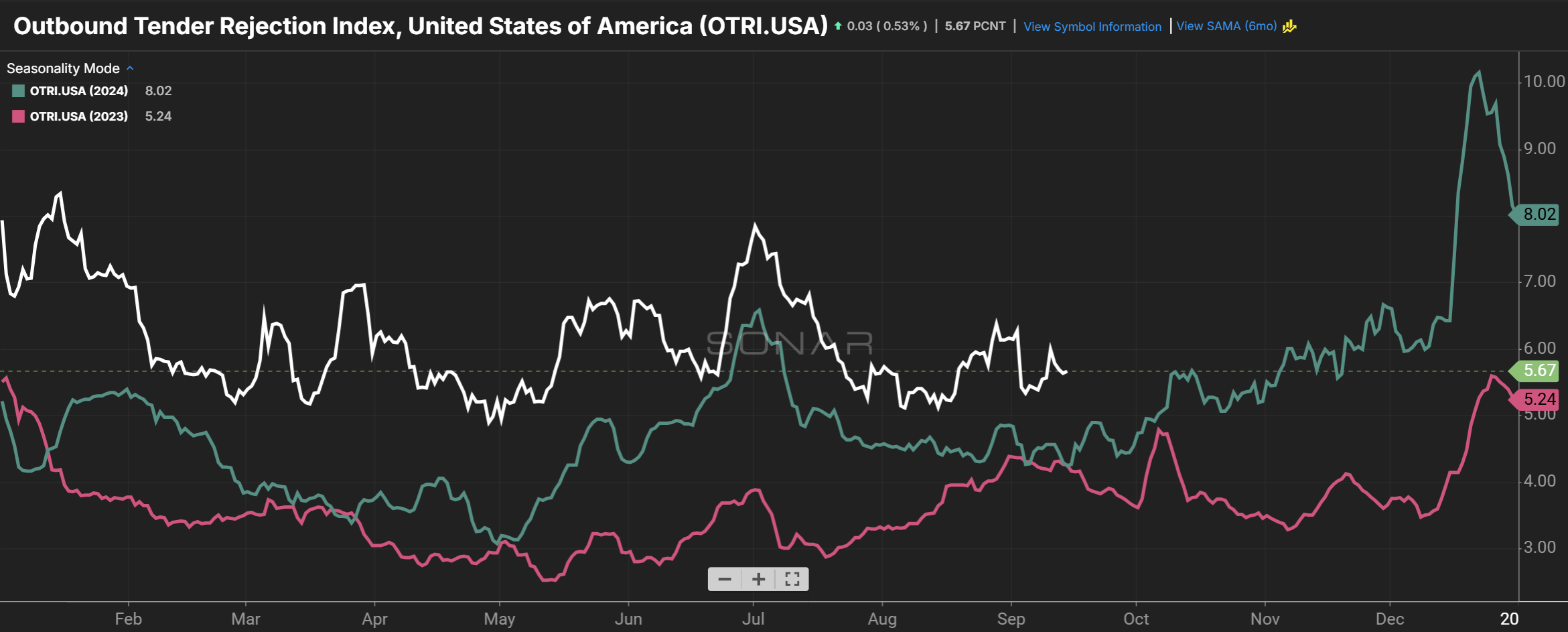
The national tender rejection rate for 2023, 2024, and 2025 is shown in pink, green, and white, respectively. (Chart: SONAR)
Tender rejection rates have been up and down in recent weeks, with the general trend upward as the seasonally strong period approaches. The national tender rejection rate of 5.67% is up 25 basis points week over week. It peaked at 6.4% just before Labor Day. In the past several months, tender rejection rates have become more sensitive to short-term changes in volume and seasonal events, which temporarily remove capacity from the market. That suggests the freight market is getting closer to equilibrium, and then, potentially again becoming a carriers’ market.
While a nearly 6% tender rejection rate is close to what I consider a freight market that is balanced between supply and demand, as carriers reject a reasonable, but not extraordinary level of tenders, contract rates remain under pressure. SONAR shows that contract rates are not keeping up with where they were a year ago, which suggests that rates are again under pressure during the fall bid season. Of the truckload equipment sectors, dry van appears to be under the most pressure. Breaking the tender rejection rate down, van, reefer, and flatbed rejection rates are 5.4%, 12.4% and 10.2%, respectively.
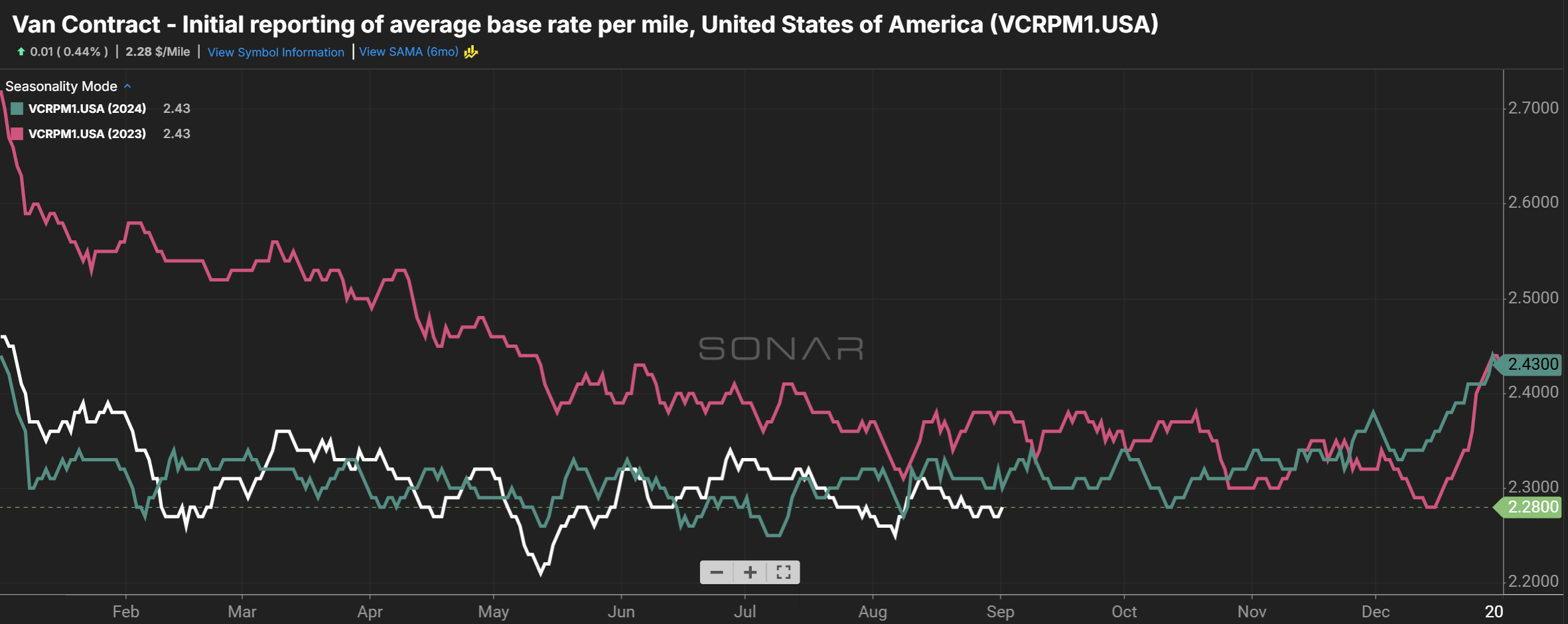
The average per-mile dry van contract rate for 2023, 2024, and 2025 is shown in pink, green, and white, respectively. (Chart: SONAR)
About the SONAR PPI: The SONAR Pricing Power Index is a qualitative assessment of the balance of negotiating power between shippers and carriers on a scale of 0 to 100 using SONAR data and anecdotes from discussions with SONAR clients. The higher the number, the tighter the freight market and the more that pricing power favors carriers. A 50 represents a balanced market. While the SONAR PPI primarily pertains to the truckload sector, given its size, dynamics in other sectors, such as intermodal and ocean, are also considered.