Largest TL carrier expects high-single to low-double digit bid renewals
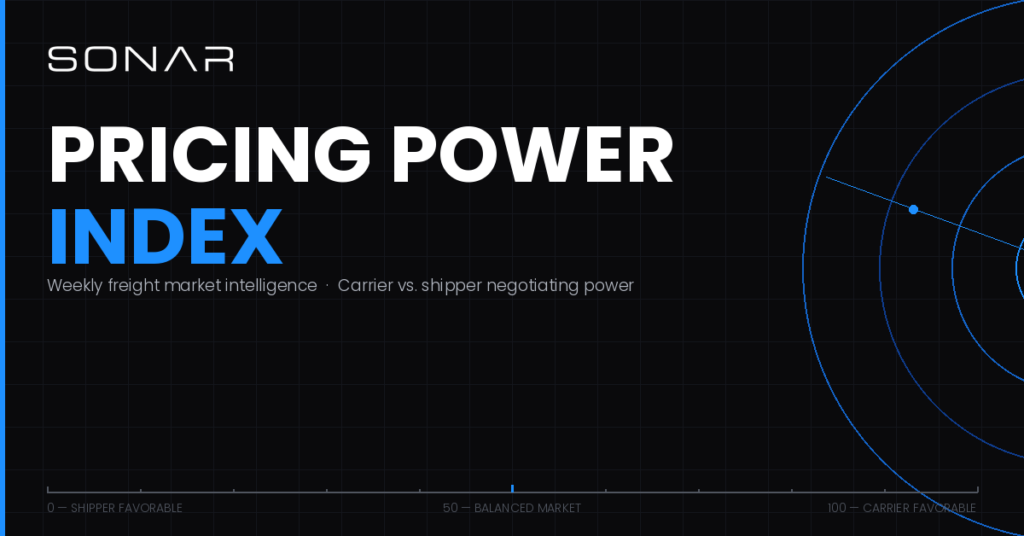
This week’s SONAR Pricing Power Index (PPI): 65 (unchanged) – The major SONAR data points did not change much in the past week. The national tender rejection rate pulled back modestly to start April, declining from 14.0% to 12.6%, in line with typical seasonal patterns, while the three major equipment segments (van, reefer, flatbed) all remained above 11%. Spot rates are similarly high and are starting to flatbed out around $3.08/mile; the run-up in recent weeks can only be partially attributed to fuel. The main thing that was incremental in the past week was comments from public carriers on their earnings calls, which served to confirm the expectation that the recent tightening will be impactful going forward.
Three-month SONAR Pricing Power Index (PPI) Outlook: 75 (unchanged) – The three-month outlook suggests that the freight market should tighten further ahead of events such as International Roadcheck (May 12-14) and Memorial Day. Carrier earnings commentary from J.B. Hunt and Knight-Swift both confirm that bid season conversations are highly constructive from carriers’ perspectives, and the recent appreciation in spot rates is leading to significantly higher repricing of contract freight.
Tender rejection rates remain over 11% in all segments

The national tender rejection rate (2026 – white line) remains far higher than the past three years. A decline to start 2Q was expected seasonally. (Chart: SONAR)
To start 2Q, the national tender rejection rate declined from 14.7% to 12.9%. The recent peak of 14.7% was the highest reading in four years — the last time the market was this tight was at the approximate onset of the freight market recession in the first half of 2022.
The comments from a carrier that stood out the most to me from earnings calls were from Knight-Swift’s management, which said that after repricing contracts with mid-single-digit contractual rate increases in its truckload business to start the year, the company is now looking for high-single- to low-double-digit increases on the remaining 70% of its book of business.


A narrow spread between spot and contract rates (top chart above) and SONAR contract rate data (second chart above), both support Knight-Swift’s assertion that contract rates are set to move sharply higher. (Chart: SONAR)
That marks a sharp shift and serves as confirmation that a pullback in rejection rates to start April is a function of seasonality. Volumes typically accelerate in May as Memorial Day approaches. In addition, the freight market may be especially responsive to International Roadcheck (May 12-14).
The main variance in nationwide tender rejection rates in the past week came in the reefer segment, which declined from 15.3% to 13.7%. According to SONAR’s Director of Freight Market Intelligence, Zach Strickland, produce runs are influencing conditions in California and Florida as early-season harvests got underway the past few weeks (the Florida market got off to a particularly early start). In addition, Mother’s Day demand could constrain reefer networks in the next two weeks.

The SONAR Truckload Rejection Index is shown above for dry van (white), reefer (green), and flatbed (red) segments. (Chart: SONAR)
Spot rates hold near $3.10/mile.
Since the start of the Iran conflict, the national average spot rate has climbed relentlessly, moving from $2.76/mile to $3.10/mile, before leveling off at $3.08 the past two weeks. Diesel prices have surged approximately 52% over the same period, climbing from roughly $3.71/gallon to a high of $5.63/gallon before retreating slightly to $5.40/gallon. Some have argued that the spot rate run-up is simply carriers passing along fuel cost increases. The second chart below presents the counterpoint that carriers can only successfully pass along higher costs when the market is tight enough to support it. And, in the tight market, the average spot rate pulled back only slightly in response to the latest drop in diesel prices.

The average spot rate for 2026 (white), 2025 (yellow), 2024 (green), and 2023 (pink). (Chart: SONAR)

The average spot rate (white), displayed in the SONAR National Truckload Index (NTI.USA), versus diesel prices (orange). (Chart: SONAR)
Tender volume pulls back to start Q2, but accepted volume is still tracking in line with year-ago levels
Total truckload tender volume — which counts both first-time tenders and loads that have been rejected and retendered — declined to start Q2 after surging to close Q1. This is another normal seasonal pattern. The volume of accepted tenders declined far less than total tenders (from the end of 1Q to early 2Q), suggesting that the drop in overall volume is largely a function of fewer retendered loads, amid tender rejection rates which are off their highs. Accepted tender volume is running roughly in line with year-ago levels. However, this understates actual freight movement relative to 2025, because it excludes loads that fall through the routing guide and move on the spot market — and spot opportunities have clearly grown meaningfully.

Truckload tender volume declined to start Q2 following the end-of-quarter surge. (Chart: SONAR)

The volume of accepted tenders is running roughly in line with year-ago levels. (Chart: SONAR)
About the SONAR PPI: The SONAR Pricing Power Index is a qualitative assessment of the balance of negotiating power between shippers and carriers on a scale of 0 to 100 using SONAR data and anecdotes from discussions with SONAR clients. The higher the number, the tighter the freight market and the more that pricing power favors carriers. A 50 represents a balanced market. While the SONAR PPI primarily pertains to the truckload sector, given its size, dynamics in other sectors, such as intermodal and ocean, are also considered.