Rejection rates remain above 13%, and carriers confirm improved freight market
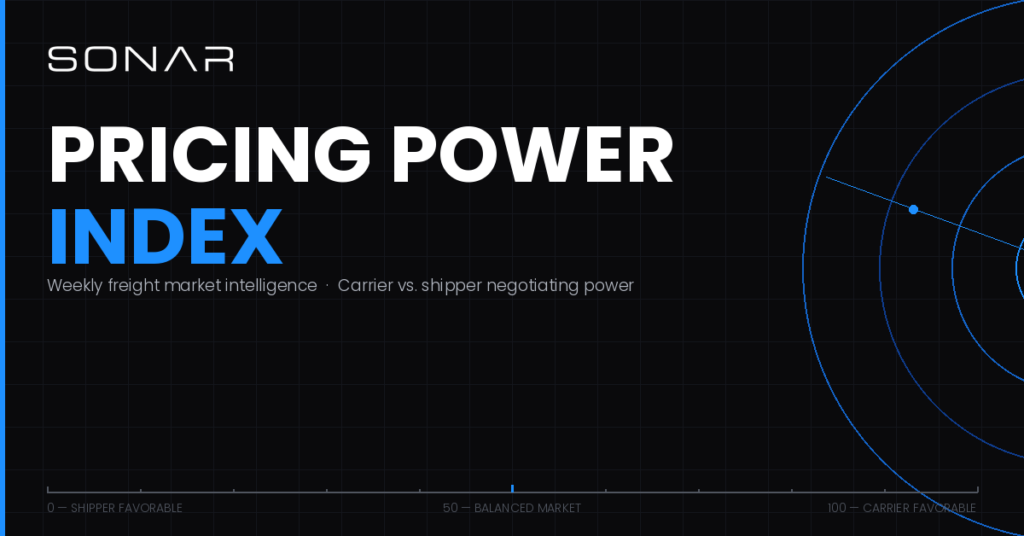
This week’s SONAR Pricing Power Index (PPI): 65 (unchanged) – The national tender rejection rate pulled back modestly to start April, declining from 14.0% to 13.1%, in line with typical seasonal patterns. Spot rates are similarly high, with an average of $3.08/mile, an all-in rate that cannot be attributed only to fuel. This week’s freight data and carrier comments to start earnings season support the view that the prior week’s pullback in a few of the SONAR data sets was only related to seasonality.
Three-month SONAR Pricing Power Index (PPI) Outlook: 75 (unchanged) – The three-month outlook suggests that the freight market should remain tight and may tighten further ahead of events such as International Roadcheck (May 12-14) and Memorial Day. Carrier earnings commentary from J.B. Hunt and Knight-Swift both confirm that bid season conversations are becoming more constructive, and the recent appreciation in spot rates should lead to higher repricings of contract freight.
Tender rejection rates remain elevated at over 13%

The national tender rejection rate (2026 – white line) remains far higher than the past three years despite a decline to start 2Q. (Chart: SONAR)
To start 2Q, the national tender rejection rate declined from 14.7% to 12.9% before trending roughly sideways in the past week to 13.1%. The recent peak of 14.7% was the highest reading in four years — the last time the market was this tight was at the approximate onset of the freight market recession in 2022. As Knight-Swift CEO Adam Miller said it the company’s earnings preannouncement, the winter weather “exposed the reduction in truckload capacity to all stakeholders, which is very meaningful for ongoing bid activity.” A pullback in rejection rates to start April is to be expected and is typically the softest month of Q2 before volumes accelerate in May. The freight market may be especially responsive to International Roadcheck (May 12-14) and Memorial Day this year. The decline also reflects fewer retendered loads – with a lower rejection rate, fewer loads flow through the routing guide a second or third time. My overall assessment of market conditions is unchanged; it has fundamentally shifted to a carriers’ market and could remain one for an extended period.
In the past week, rejection rates rebounded in the flatbed segment after pulling back the prior week from a highly elevated level. The 42.1% flatbed rejection rate reflects tremendous tightness, largely driven by the buildout of data centers. The dry van and reefer segments are also showing far higher tender rejection rates than they were in recent years to start the 2Q with current rejection rates of 11.6% and 15.3%, respectively. On its first-quarter earnings call, J.B. Hunt’s management said that some customer segments that had been lagging have stabilized, such as furniture and exercise equipment.

The SONAR Truckload Rejection Index is shown above for dry van (white), reefer (green), and flatbed (red) segments. (Chart: SONAR)
Spot rates hold above $3.00/mile for now; the coming weeks may serve as a test given Friday’s decline in oil prices

The average spot rate (white), displayed in the SONAR National Truckload Index (NTI.USA), versus diesel prices (orange). (Chart: SONAR)
Since the start of the Iran conflict, the national average spot rate has climbed relentlessly, moving from $2.76/mile to $2.82/mile, then $2.98/mile, then $3.10/mile, before easing fractionally to $3.09/mile and $3.08/mile last week and this week, respectively. Diesel prices have surged approximately 52% over the same period, climbing from roughly $3.72/gallon to over $5.65/gallon in March — the highest level since mid-2022. Some have argued that the spot rate run-up is simply carriers passing along fuel cost increases. The chart above provides the counterpoint that carriers can only successfully pass along higher costs when the market is tight enough to support it. Knight-Swift CEO Adam Miller spun this as a potential positive for the industry in its Q1 pre-announcement, noting that the rapid rise in fuel costs was a headwind to Q1 earnings due to the lag impact of fuel surcharges, because it could contribute to a faster reduction of industry capacity.
Tender volume pulls back to start Q2, but accepted volumes track in line with year-ago levels
Total truckload tender volume — which counts both first-time tenders and loads that have been rejected and retendered — declined to start Q2 after surging to close Q1. This is another normal seasonal pattern. The volume of accepted tenders declined far less than total tenders, implying that the drop in overall volume is largely a function of fewer retendered loads, not a collapse in underlying demand. Accepted tender volume is running roughly in line with year-ago levels. However, this understates actual freight movement relative to 2025, because it excludes loads that fall through the routing guide and move on the spot market — and spot opportunities have clearly grown meaningfully.

Truckload tender volume declined to start Q2 following the end-of-quarter surge. (Chart: SONAR)

The volume of accepted tenders is running roughly in line with year-ago levels. (Chart: SONAR)
About the SONAR PPI: The SONAR Pricing Power Index is a qualitative assessment of the balance of negotiating power between shippers and carriers on a scale of 0 to 100 using SONAR data and anecdotes from discussions with SONAR clients. The higher the number, the tighter the freight market and the more that pricing power favors carriers. A 50 represents a balanced market. While the SONAR PPI primarily pertains to the truckload sector, given its size, dynamics in other sectors, such as intermodal and ocean, are also considered.